
PAN India — B2B Distribution Network
PAN India — B2B Distribution Network

Posted on 8th Aug 2026 by Admin
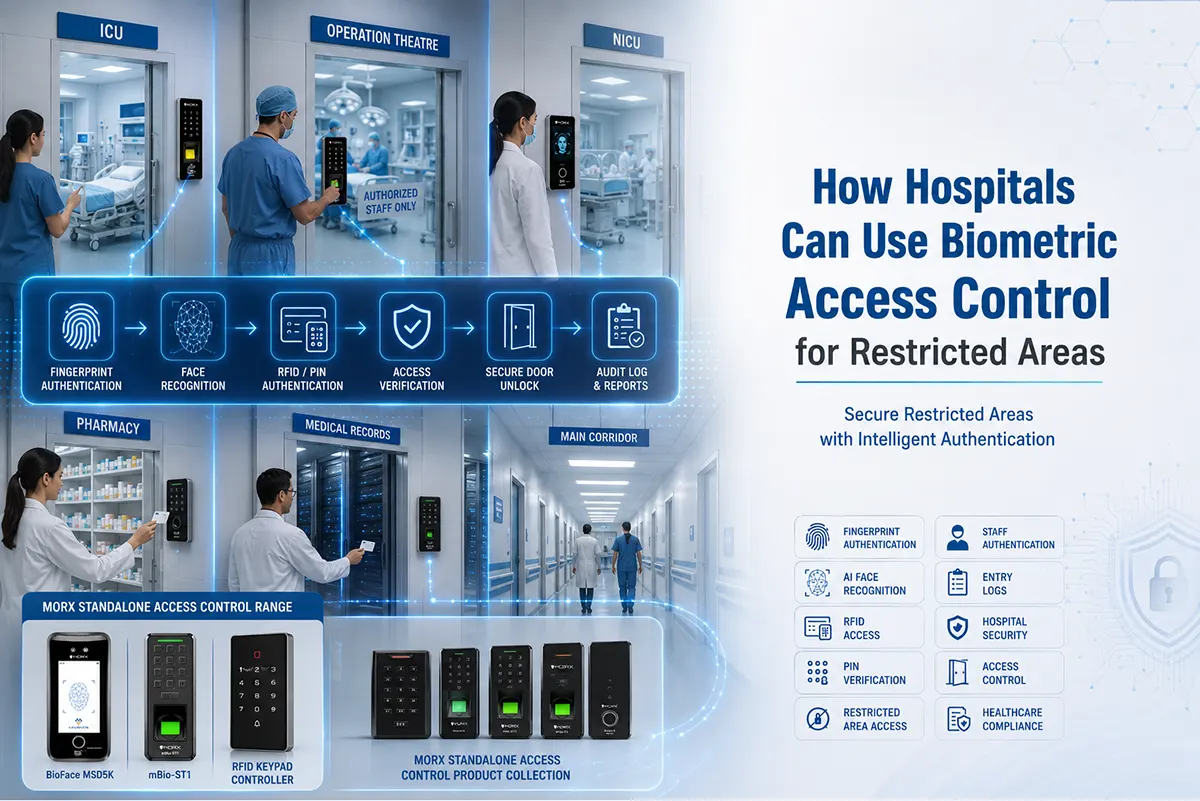
A hospital has more restricted zones than almost any other building type — the ICU, the operation theatre, the pharmacy and narcotics store, the NICU, the blood bank, the server room holding patient records. Each of these needs a different level of access, for a different group of people, often around the clock. A shared key or a single master card doesn't scale to this — every duplicated key or lost card becomes a security gap that's difficult to trace back to a person.
Biometric access control solves the core problem differently: it ties entry to an individual's fingerprint or face rather than something they carry, which means access can be granted, restricted, or revoked instantly, and every entry attempt is logged against a real identity. This article looks at how hospitals actually apply this across different restricted zones.
A corporate office typically has one or two access tiers — employee and visitor. A hospital has many more, and they don't map cleanly onto each other. A nurse may need ICU access during her shift but not pharmacy access. A surgeon needs OT access but only during scheduled procedures. A cleaning staff member needs limited-hours access to almost every ward but should never enter the narcotics store. Visitors need to be kept out of nearly everything beyond common areas.
Card-based systems handle some of this, but cards get shared, borrowed, or lost — and a lost access card to a narcotics store or a server room is a genuine liability, not just an inconvenience. Biometric identification removes the "shared credential" problem entirely, because a fingerprint or face cannot be handed to a colleague the way a card can.
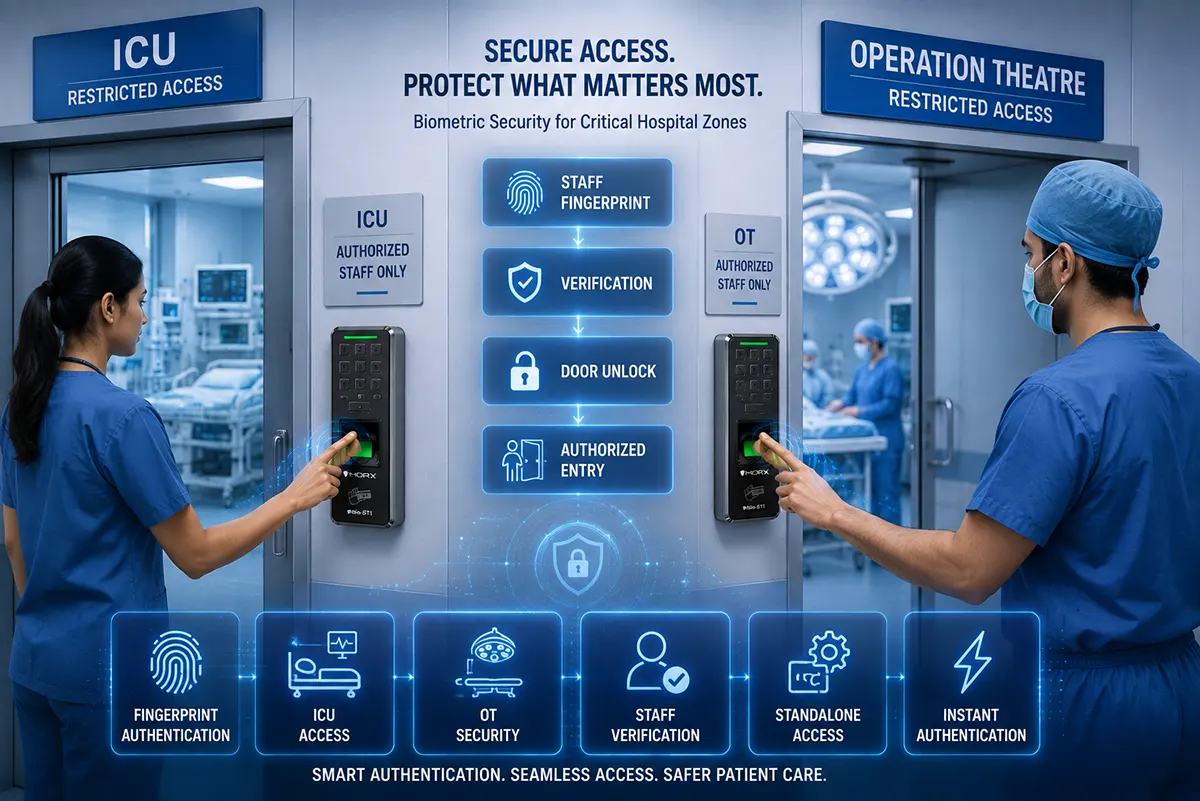
For areas like the ICU, operation theatre, and general staff-only wards, fingerprint-based standalone access control is the most widely deployed method — fast, accurate, and simple to manage at the door level without needing a centralized server for every entry point.
A standalone fingerprint access system like the mBio ST1 operates independently at each door — the hospital's IT or facilities team enrolls authorized staff fingerprints directly on the device, and each unit manages its own access list without depending on network connectivity to function. This matters in hospital environments specifically, because a door that stops working during a network outage is not an acceptable failure mode for an ICU or OT entrance — a standalone unit keeps working regardless of what the hospital's broader IT infrastructure is doing at that moment.
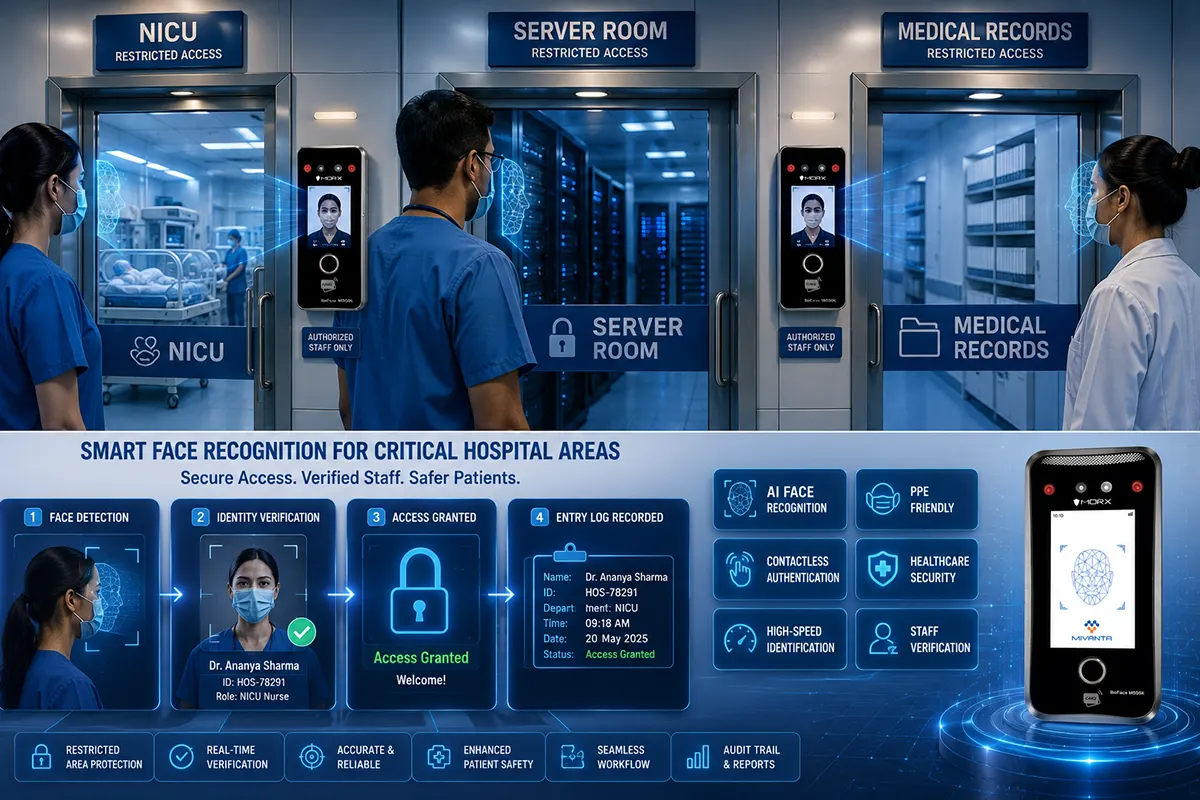
Some hospital zones need faster verification without any physical contact — a consideration that matters even more in clinical settings where hand hygiene protocols are strict. Face recognition attendance and access devices identify staff in under a second without requiring anyone to touch a sensor, which is why they're increasingly used at NICU entrances, server rooms holding electronic health records, and administrative zones with high staff traffic during shift changes.
The Morx BioFace MSD5K supports up to 5,000 enrolled faces with AI-based recognition that continues to identify staff accurately even as their appearance changes over time — relevant in a hospital where staff wear masks, caps, or PPE for parts of their shift, and the system needs to remain reliable regardless.
For the highest-sensitivity areas — narcotics cabinets, pharmacy stock rooms, records archives — hospitals often add a second authentication factor rather than relying on biometric alone. A keypad RFID access control unit like the SEM03 combines a PIN code with card-based verification, giving these specific zones a dual-authentication requirement: something the staff member knows (PIN) plus something they carry (card), layered on top of or alongside biometric identification at the main entry point.
This layered approach matters for narcotics storage in particular, since regulatory audits typically expect more than single-factor access control at these specific points, even when the rest of the facility runs on fingerprint or face recognition alone.
Every biometric access event — successful or denied — gets logged with a timestamp and an identity. In a hospital, this record has value beyond security. If a controlled substance goes missing from the pharmacy, the access log narrows down who entered that specific room and when, rather than leaving the investigation to a shared master key with no record of who used it. If there's a dispute over who had access to a patient's records at a specific time, the server room's biometric log provides a verifiable answer.
This is also the practical difference between biometric access control and a lock-and-key system for a hospital administrator dealing with a compliance audit: a key-based system can tell you who theoretically had a copy of the key; a biometric system tells you who actually entered, and when.
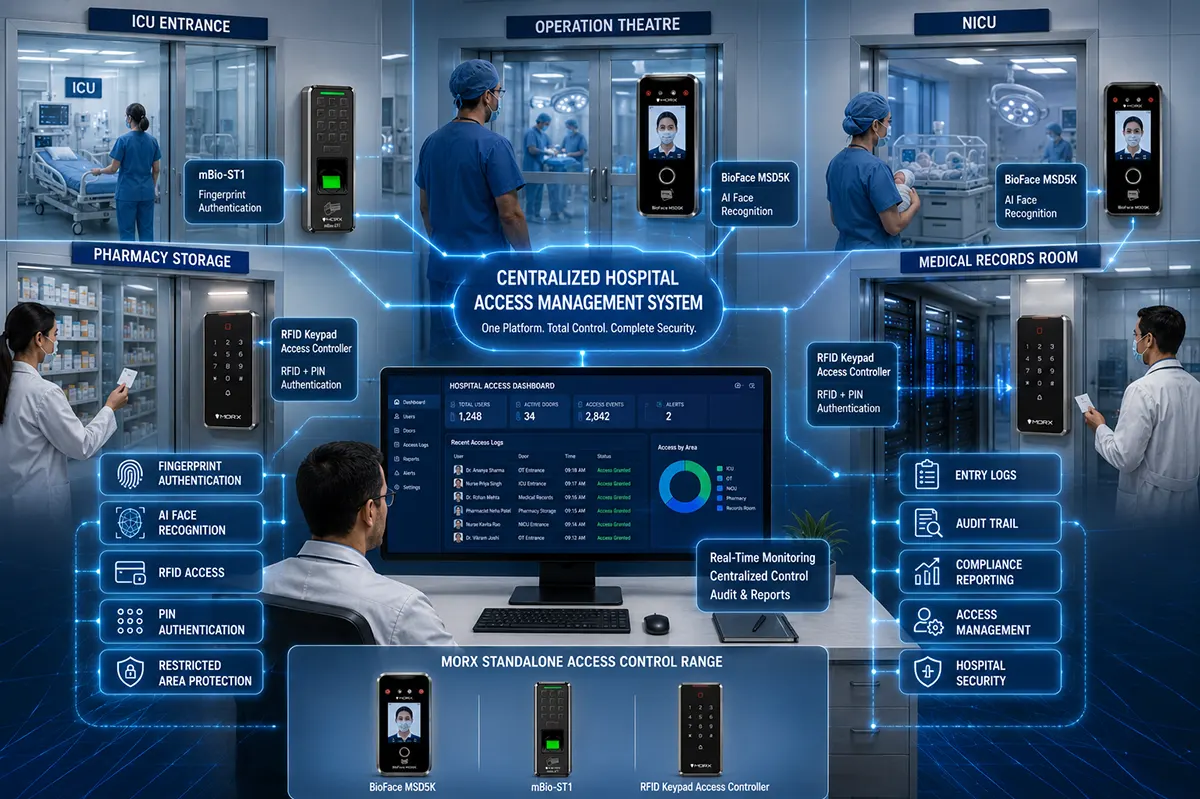
Not every hospital door needs the same setup. Standalone units — like the mBio ST1 and ST2 — are well suited to individual high-security doors (a single OT, a single pharmacy store) where independent operation and simple management matter more than centralized reporting across dozens of doors. For hospitals managing access across many doors and wanting a single consolidated log — every ICU, every ward, every restricted store reporting to one system — a networked setup connecting multiple biometric devices through a central controller gives facilities and security teams one dashboard instead of checking each door's local log individually.
Most hospitals end up with a mix: standalone units at a handful of highest-sensitivity single doors, and networked biometric access across the wards and administrative zones where centralized reporting adds real operational value.
Both work reliably for staff-only zones. Face recognition adds a hygiene advantage since no physical contact is needed, which matters more in clinical environments with strict hand hygiene protocols. Fingerprint remains a reliable, lower-cost option for staff-only doors where contact isn't a specific concern.
Standalone units continue operating on local power backup and manage their own access list independently of network connectivity, so a network outage doesn't lock staff out of critical areas like the ICU or OT.
Most hospitals add a second authentication factor — a PIN or RFID card alongside biometric — specifically for narcotics and controlled-substance storage, since compliance requirements typically expect more than single-factor access at these points.
Every access attempt is logged against a real identity with a timestamp, giving auditors a verifiable record of exactly who entered a restricted area and when — something a shared key or master card cannot provide.
Mivanta supplies biometric access control systems — standalone fingerprint units, face recognition devices, and keypad RFID controllers — to hospitals and healthcare facilities across India as a B2B distributor. Explore the complete Stand Alone Access Control range, or contact our sales team for a zone-by-zone access control consultation.

Subscribe to our emails about secure life. No spam.