
PAN India — B2B Distribution Network
PAN India — B2B Distribution Network

Posted on 2nd Jul 2026 by Admin
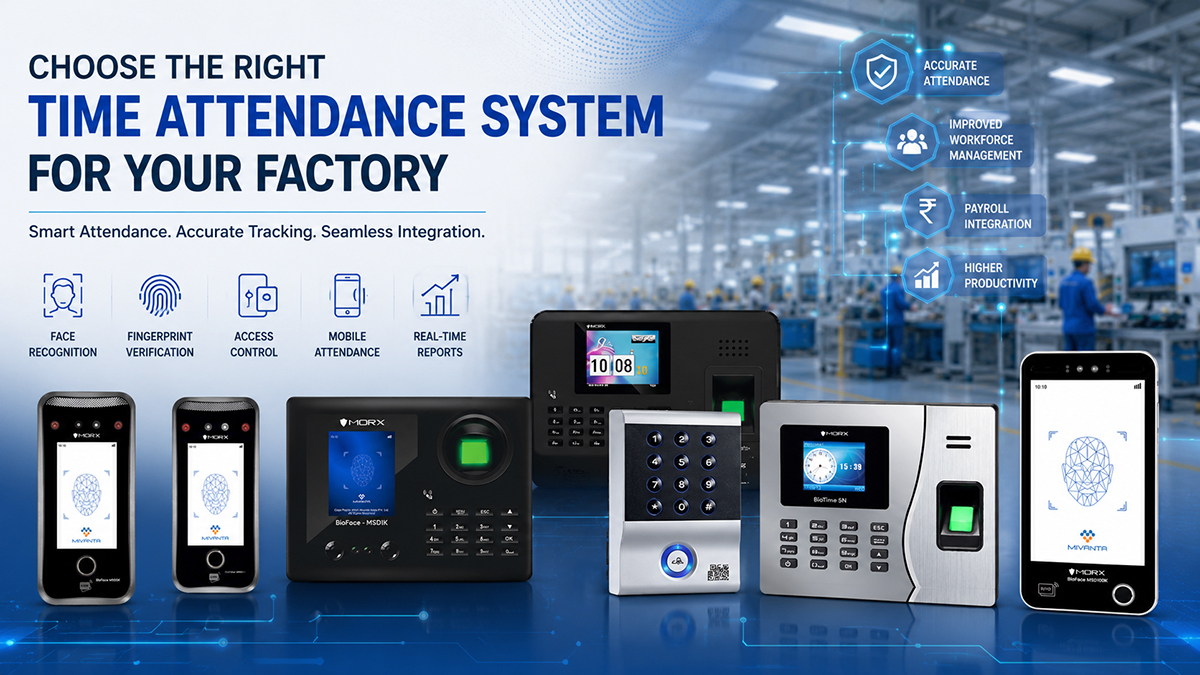
Managing attendance in a factory is not the same as managing it in an office. Factories have rotating shifts, large workforces spread across multiple entry points, dusty or humid shop floors, workers with rough or oily hands, and payroll systems tied directly to shift hours. A basic fingerprint device that works perfectly in a 30-person office will struggle or fail completely in a 500-person manufacturing plant.
This guide walks you through everything a factory manager, HR head, or security integrator needs to know before selecting a time attendance system — the types available, the factory-specific factors that actually matter, how to match a device to your workforce size, and which products are built for industrial environments.
Most buyers compare time attendance systems on features like touchscreen size or Wi-Fi connectivity. For factories, the real decision criteria are different:
Worker volume at shift change: When 200 to 500 workers punch in within a 15-minute window, a slow device creates bottlenecks at the gate. Verification speed — measured in seconds per person — is a critical spec.
Hands that do not cooperate with standard sensors: Workers in manufacturing, construction, or chemical plants often have worn fingerprints, cuts, chemical residue, or moisture on their hands. A standard optical sensor that works indoors fails here. You need sensors with high tolerance for poor-quality fingerprints.
Multiple entry points: A factory with separate gates for production floor, warehouse, canteen, and office needs a networked system — not four standalone devices that cannot talk to each other.
Shift-based payroll: Factory payroll runs on shift hours, overtime calculations, late penalties, and night shift allowances. The attendance device must integrate with software that handles these rules, not just export a raw log.
Harsh environment: Dust, humidity, temperature extremes, and vibration. A consumer-grade device will not survive on a factory floor.
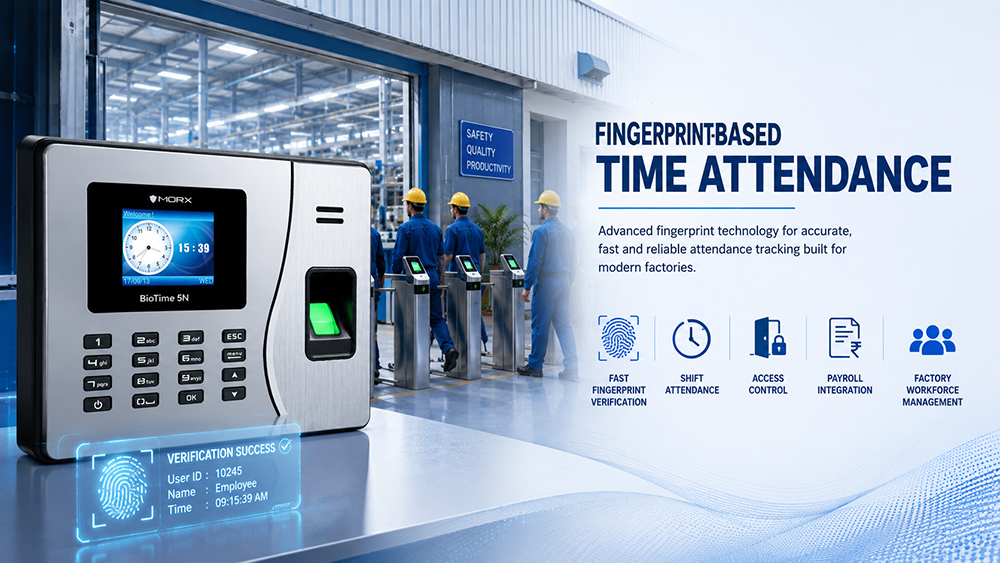
The most widely deployed type across Indian factories. Workers register their fingerprint once, and the device verifies identity in under a second at every punch-in.
Best for: Factories with 50 to 500 workers, standard manufacturing environments, and HR departments that want a cost-effective, proven solution.
Limitation: Workers with worn, dry, or chemically-affected fingerprints may face frequent rejections. In such cases, look for optical sensors with high FAP tolerance or pair fingerprint with card backup.
The MORX BioTime 5N combines fingerprint time attendance and access control in a single device — reducing hardware cost and installation complexity. It is well-suited for factory units that need reliable attendance tracking at entry gates without a complicated setup.
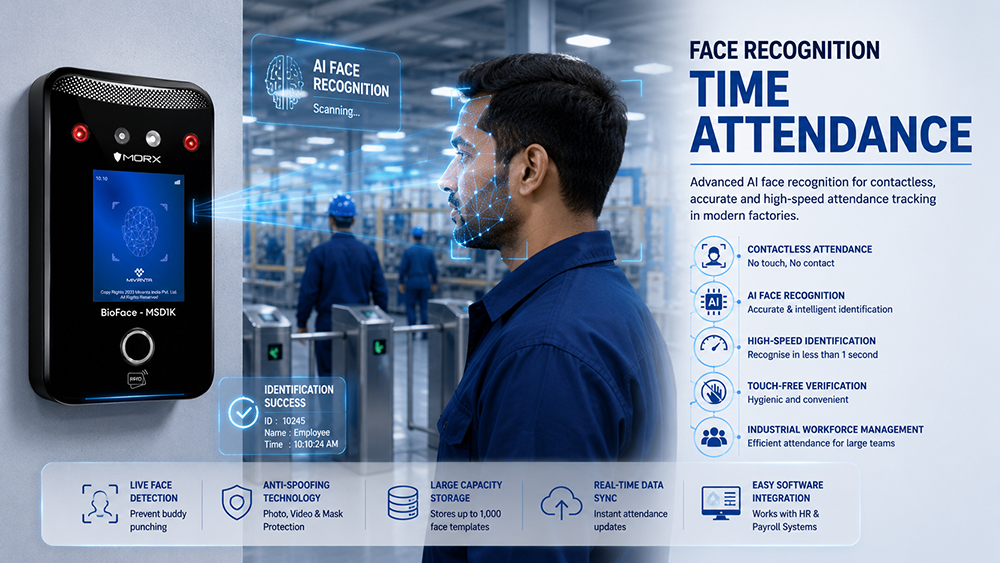
Face recognition devices have become the preferred choice for factories with large workforces because they solve the biggest problem with fingerprint systems — hand condition. Workers do not need to touch anything. They walk up to the device, it captures their face, and they are marked present in under a second.
Best for: Factories with 200+ workers, food processing plants, chemical plants, automotive, and any facility where hand condition is an issue.
Modern face recognition devices come with IR cameras that work in low light, direct sunlight, and high-volume shift change conditions. The BioFace MSD5K supports 5,000 face templates using AI dynamic face recognition — meaning it continues to recognise workers even as their appearance changes over time. For larger industrial complexes, higher-capacity models in the BioFace series go up to 100,000 face templates.
Explore Mivanta's full range of Face Recognition Devices to compare models across capacity tiers.
The latest generation of attendance hardware uses AI algorithms for both face recognition and liveness detection. These devices do not just match a face — they verify that a real, live person is standing in front of the camera, preventing buddy punching (one worker marking attendance for another using a photo).
Best for: Factories where attendance fraud is a concern, government-contracted plants with compliance requirements, and organisations moving toward workforce analytics.
Web-based attendance terminals connect directly to a browser-accessible server, eliminating the need for dedicated software installation on each HR workstation. Attendance data is accessible in real time from any device on the factory network.
Best for: Multi-location factories, organisations with a central HR team managing attendance across plants, and setups where IT infrastructure is limited.
Every attendance device has a maximum number of fingerprint or face templates it can store. Map your current headcount, add 20 to 30 percent growth buffer, and choose a device whose user capacity comfortably covers that number.
At shift change, your gate needs to process one worker every 1 to 2 seconds. For factories with 300+ workers punching in together, choose devices with dedicated AI chips that maintain speed under load.
The IP rating tells you how well a device resists dust and moisture. For factory floors, look for a minimum of IP54. For outdoor gates or humid environments, IP65 or higher is required.
For a networked multi-gate factory, devices must connect over TCP/IP (Ethernet or Wi-Fi) to a central server. Also confirm whether the device supports RS485 for wired connections in areas with poor Wi-Fi coverage.
Factory power fluctuations can cause attendance data loss or device reboots at critical moments. Ensure a Mini UPS is installed at each terminal to keep devices running through short power cuts.
The hardware is only half the system. Attendance data needs to flow into software that calculates shift hours, overtime, late marks, leaves, and payroll deductions. Without proper software, your HR team is manually processing exported Excel files every month.
Mewurk is a complete workforce management solution that handles attendance, leave management, shift scheduling, and HR workflows — built to integrate directly with biometric attendance hardware.
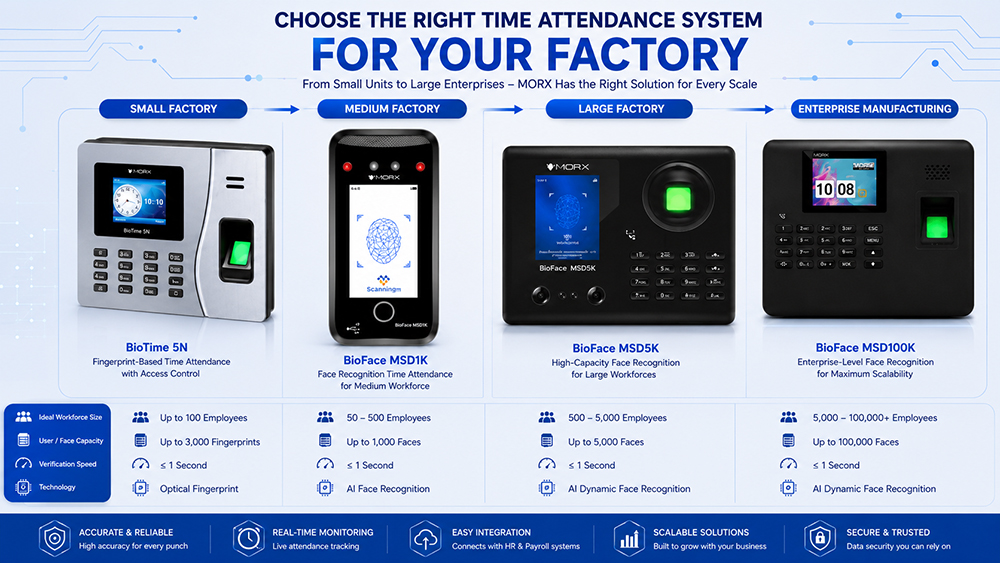
| Factory Size | Recommended Type | Products to Consider |
|---|---|---|
| Up to 100 workers | Standalone Fingerprint | BioTime MR110, BioTime 16, mBio G1 |
| 100–500 workers | Networked Fingerprint or Face Recognition | BioTime 5N, BioFace MSD1K, BioFace MSD2K |
| 500–2,000 workers | AI Face Recognition, Multi-gate Networked | BioFace MSD5K, BioFace MSD20K |
| 2,000+ workers | High-Capacity AI Face Recognition | BioFace MSD50K, BioFace MSD100K |
Buying the cheapest device and replacing it in 12 months. Entry-level consumer devices are not built for continuous industrial use. Total cost of ownership — including downtime, replacement, and re-enrollment of workers — is higher than buying the right device upfront.
Not accounting for shift-change peak load. A device that processes 300 identities per hour sounds adequate until you realise all 300 workers arrive in the same 10-minute window.
Skipping the software integration step. Hardware without software just gives you a log file. The value of biometric attendance is in automated payroll, shift reports, and compliance documentation.
Installing devices without a backup power plan. A device that goes offline during punch-in creates unverified attendance records that HR has to manually reconcile.
Not training workers on enrollment quality. The first fingerprint or face enrollment sets the quality benchmark for all future verifications. Poor enrollment leads to persistent rejection issues. Invest time in proper initial enrollment.
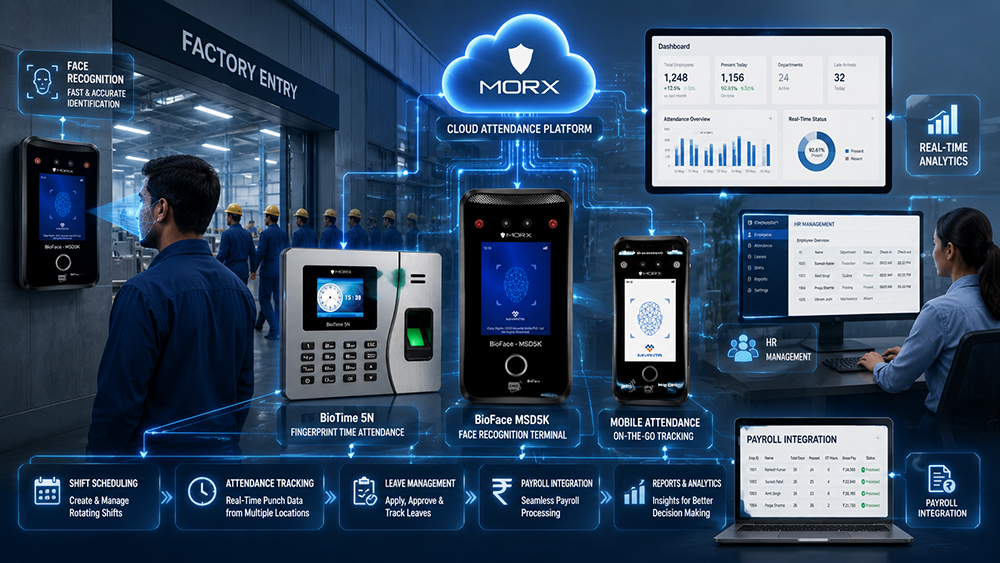
For most Indian factories, face recognition is the more reliable long-term choice because it is not affected by hand condition. Workers in manufacturing, automotive, chemical, or food processing plants often have hands that do not cooperate with fingerprint sensors. For smaller factories with office-like environments, fingerprint systems remain cost-effective and accurate.
Each entry and exit point needs its own device. If workers enter and exit through the same gate, one device per gate is sufficient. If entry and exit are separate, you need devices at both. All devices should be networked to a central server so attendance records are consolidated automatically.
Most modern attendance systems export data in standard formats that can be imported into payroll software. For seamless automated integration, use dedicated workforce software like Mewurk that connects directly with biometric hardware and handles shift-based payroll rules.
Quality devices store attendance logs locally in internal memory and sync to the server when connectivity is restored. Always verify the local storage capacity — it should handle at least 30 days of attendance records offline.
Choosing a time attendance system for your factory depends on your workforce size, shift structure, environment conditions, and how attendance data connects to your payroll process. Start by mapping these four factors, then select the device type and capacity accordingly.
Explore Mivanta's complete Time Attendance & Access Control System range — covering standalone fingerprint devices, AI face recognition terminals, web-based systems, and workforce software. Contact the Mivanta team for B2B pricing, bulk supply, and project-level consultation.

Subscribe to our emails about secure life. No spam.