
PAN India — B2B Distribution Network
PAN India — B2B Distribution Network

Posted on 11th Jul 2026 by Admin
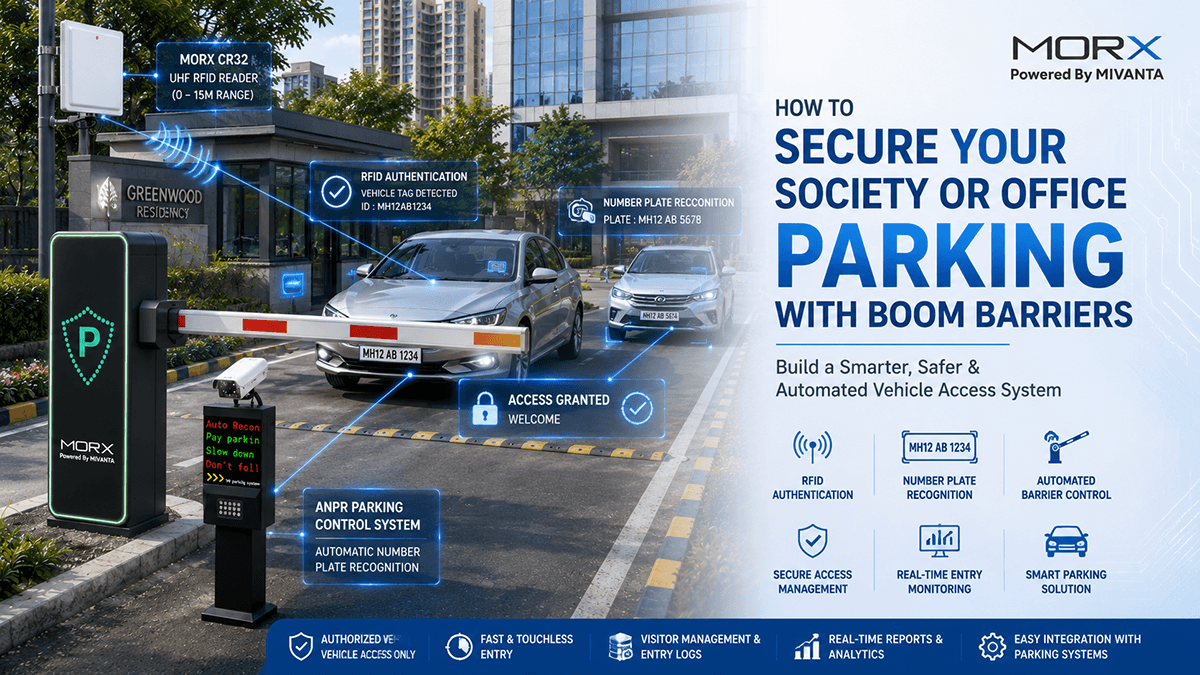
Every residential society and office building has the same problem at the gate. Someone tailgates behind an authorized car and enters without registering. A visitor parks for three hours without signing in. A vendor walks in claiming to be a delivery person. A domestic worker has her own copy of the remote because a resident gave it to her six months ago.
A boom barrier at the entry point helps — but a boom barrier alone is not a security system. It is a pole that goes up and down. What makes it a security system is everything around it: how vehicles are identified before the gate opens, how visitors are logged, and how unauthorized access is blocked without creating queues during peak hours.
This guide walks you through exactly how to build proper boom barrier-based parking security for a residential society, office complex, or commercial building — from hardware selection to the full setup.
A boom barrier is a pole-style physical barrier mounted on a motorized housing that controls vehicle entry and exit at a gate. When triggered by an authorized signal — RFID tag, licence plate recognition, remote control, or manual button — the arm raises, the vehicle passes through, and the arm lowers automatically after the vehicle clears the loop sensor below.
Modern boom barriers use brushless DC motors, which deliver faster open/close speeds, lower noise, and significantly longer service life compared to the AC motor barriers that were standard a decade ago. A brushless motor also handles far more cycles per hour without overheating — which matters at a 500-unit society gate during morning peak hours when 80 to 100 cars pass through in 20 minutes.
The MB200 Boom Barrier from Morx handles entrance widths up to 6 metres — covering standard two-lane society gates, basement parking entry points, and commercial complex entries. It includes an interactive LED chassis for night-time visibility, a programmable control panel, and a brushless DC motor for reliable high-cycle operation.
A barrier without an identification system attached to it is just a manually operated gate with extra steps. Anyone who has the remote can open it. Residents hand remotes to domestic help. Visitors keep remotes after leaving. Old remotes that should have been deactivated keep working for months.
Real parking security requires three layers working together:
Layer 1 — Identification: Who is this vehicle? Is it a registered resident, a registered employee, or an unregistered visitor?
Layer 2 — Access Decision: Should this vehicle be allowed in right now? Is it on a blacklist? Is the visitor pre-approved?
Layer 3 — Record Keeping: When did this vehicle enter? When did it exit? How many vehicles are currently parked inside?
Without all three, you have a gate. With all three, you have a parking security system.
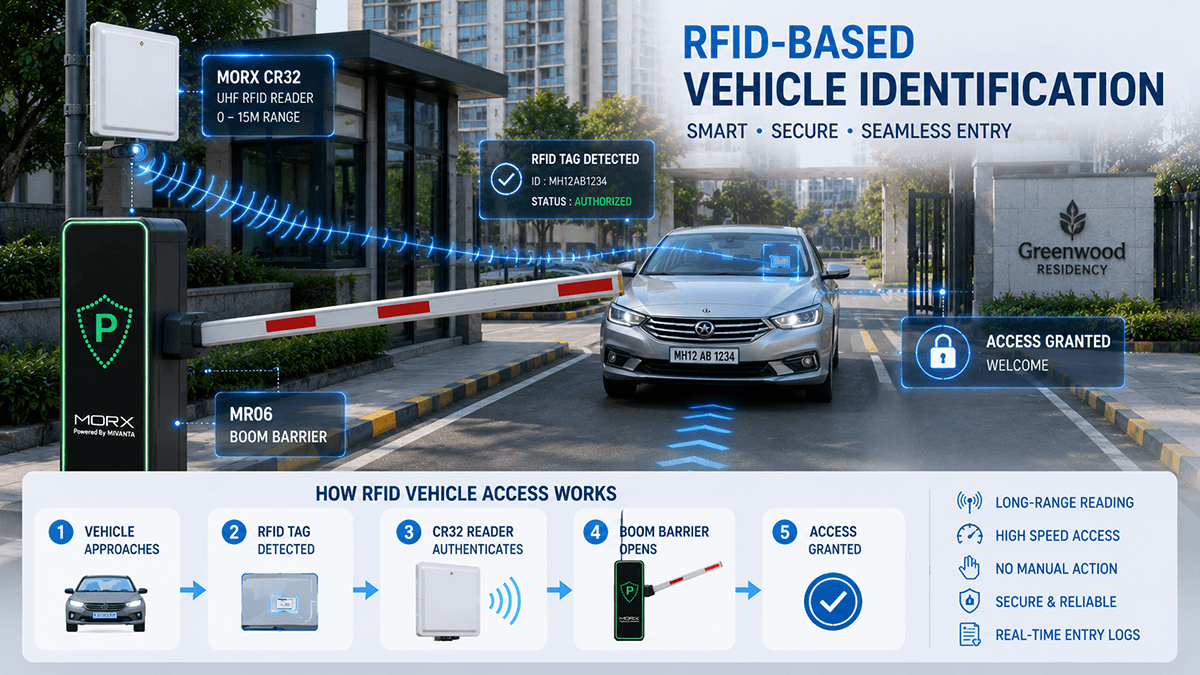
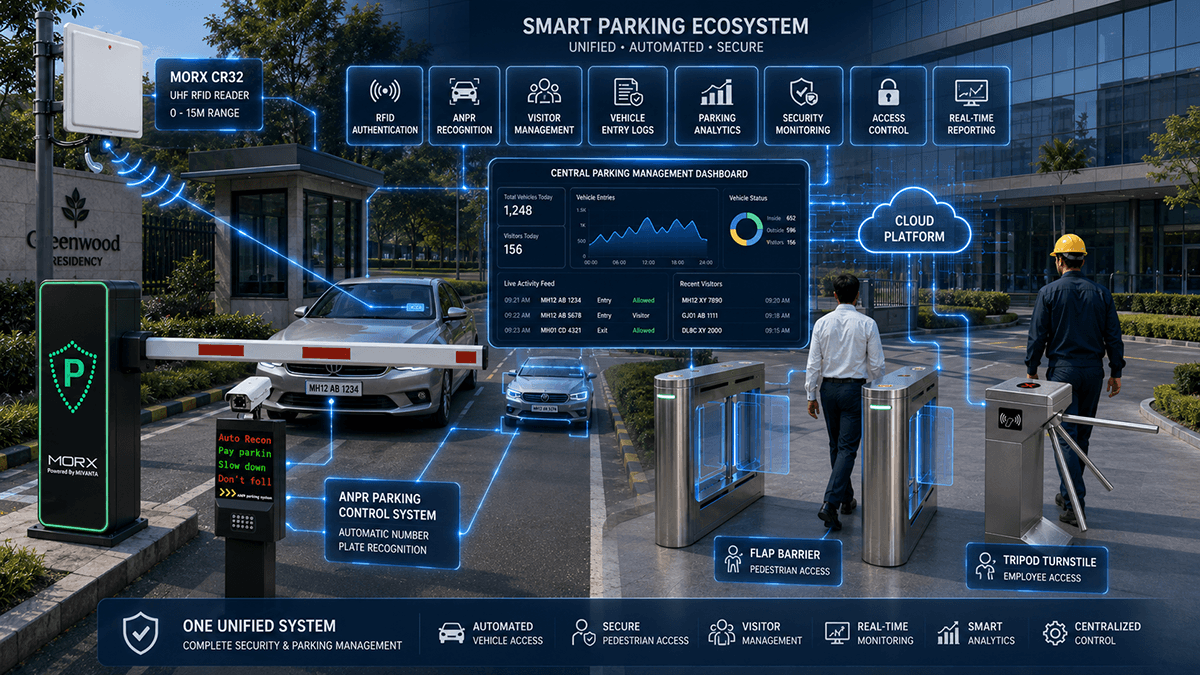
UHF RFID is the most widely deployed vehicle identification technology for societies and office parking in India. Each registered vehicle has a small windshield RFID tag. When the vehicle approaches the barrier, a long-range UHF reader mounted near the entry reads the tag from 10 to 15 metres away — before the car reaches the boom barrier — and triggers the gate to open automatically. The driver does not need to stop, roll down the window, or press anything.
This matters most at morning peak hours. When 80 to 100 cars arrive between 9:00 and 9:20 AM, a system that requires each driver to stop and swipe a card or press a button creates a 15-car queue. A UHF reader that reads at driving speed handles each car in under a second — no queue, no delay.
The MORX CR32 UHF RFID Integrated Reader has a built-in relay output that connects directly to a boom barrier with no additional controller or middleware required. Its reading range is 0 to 15 metres with a 12 dBi linear antenna, and it supports RS232, Wiegand 26/34, and trigger interfaces. One reader, one barrier, one cable — the simplest and most reliable RFID parking setup available.
For wider lanes or larger campuses where vehicles move faster, the MORX CR20 (20-metre read range) and MORX CR32L (15m with TCP/IP for multi-gate networked installations) handle more demanding deployments. See the complete UHF Integrated Reader range to compare models by read range and interface.
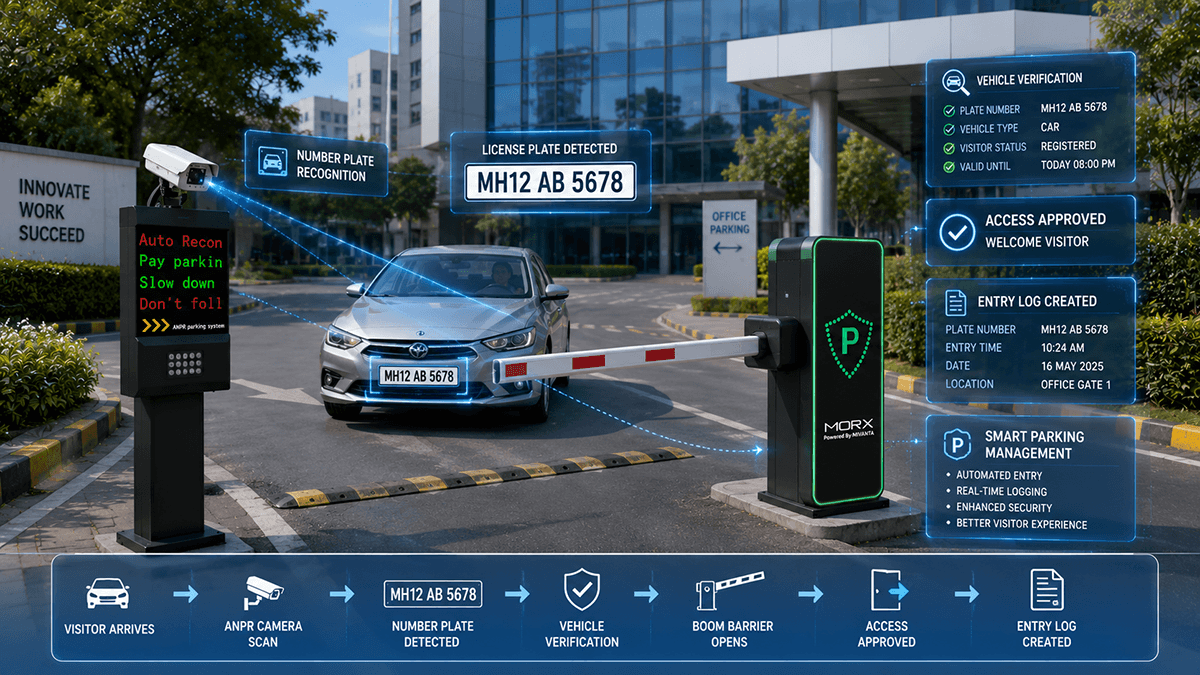
Resident and employee vehicles carry RFID windshield tags. Visitor vehicles do not. This is where ANPR — Automatic Number Plate Recognition — solves the problem.
An ANPR camera reads the licence plate of every vehicle approaching the gate, matches it against a database of registered plates and pre-approved visitors, and opens the barrier if there is a match. For unregistered visitors, the system captures the plate number, logs the entry time, and either alerts the security cabin for manual verification or holds the barrier until the guard approves entry from the desk.
The ANPR Parking Control System from Morx combines automatic licence plate recognition with parking access control in one integrated unit — covering both the camera and the access control logic in a single device without needing a separate server.
ANPR is essential at any installation where:
The recommended setup: RFID for residents and employees + ANPR for visitors and unregistered vehicles. Both feed into the same barrier at the same gate.
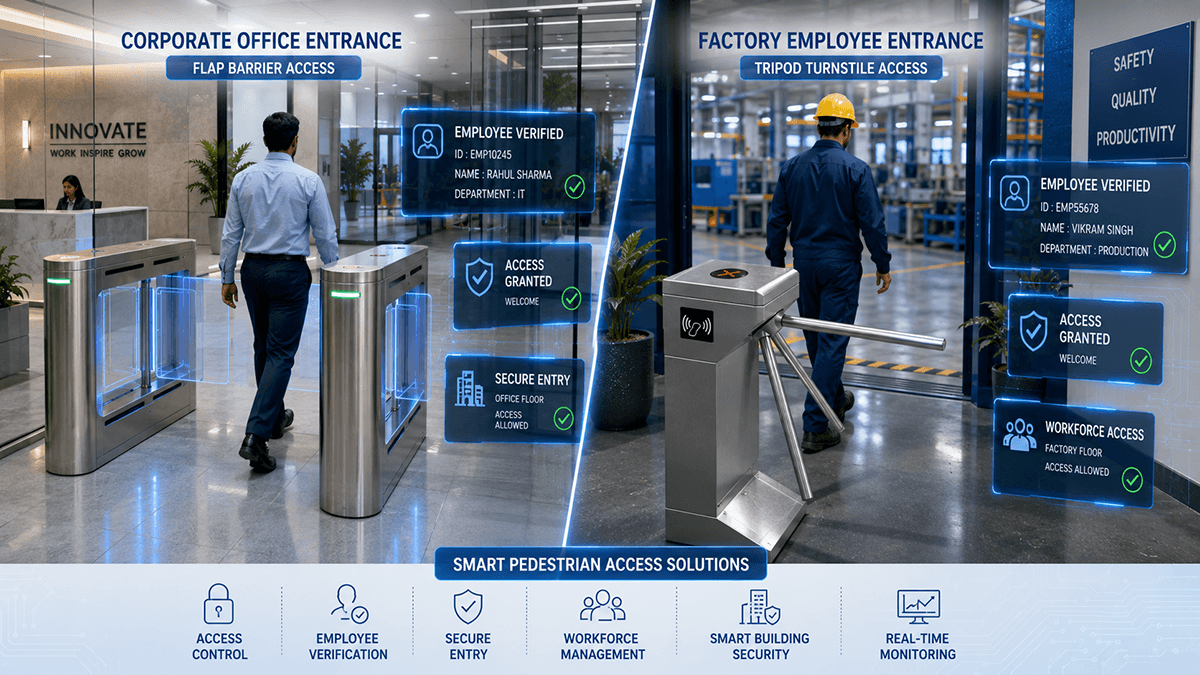
A vehicle boom barrier controls cars at the main gate. For pedestrian entry at the same facility — employees entering the office building, residents entering the lobby, workers entering the factory floor — flap barriers and tripod turnstiles handle foot traffic at separate pedestrian lanes.
A Flap Barrier uses retractable panels that open when an authorized card, RFID, or biometric is presented. It handles higher pedestrian throughput than a tripod turnstile and suits corporate office lobbies, premium residential buildings, and IT parks where aesthetics and fast throughput both matter.
A Tripod Turnstile is the standard solution for factory gates, warehouse access points, canteen entry lanes, and any high-footfall location where cost efficiency matters more than appearance. Both connect to the same access controller and biometric devices already deployed at the site — no separate infrastructure needed.
For the full range of entrance automation hardware including barriers, flap barriers, turnstiles, and access controllers, see the Entrance Automation section on Mivanta.
Standard society and office entry gates need 3 to 6 metres of arm coverage. The MB200 covers up to 6 metres, handling both single-lane and two-lane gates without arm extensions.
How many open/close cycles can the barrier handle per hour? At peak hours in a 500-unit society or a 1,000-employee office, you need a barrier rated for 600 or more cycles per hour without thermal cutoff.
Brushless DC motors are the only practical choice for high-traffic installations. They run quieter, last longer, and handle continuous operation without overheating. Avoid barriers with AC motors for any installation with more than 200 daily vehicle movements.
Confirm the barrier accepts relay input (standard on all modern barriers) and that your chosen UHF reader or ANPR system has a compatible output. The MORX CR32 has a direct inbuilt relay specifically designed for zero-integration boom barrier connection.
A barrier that fails during a power cut blocks every resident from entering or leaving. Install a Mini UPS inside the barrier housing to keep it operational through short power interruptions. This is not optional for any 24/7 residential or commercial installation.
Yes — a boom barrier can be triggered by a remote control, push button, or vehicle loop detector. But without a vehicle identification system, any person with a remote can open the gate. For security rather than just traffic management, pair the barrier with UHF RFID for registered vehicles and ANPR for visitors.
The MORX CR32 reads windshield RFID tags from 0 to 15 metres with its 12 dBi linear antenna under standard conditions. At normal vehicle approach speed, the gate opens before the car reaches the barrier — no stopping required.
The ANPR camera captures the vehicle's number plate and checks it against the pre-approved visitor list. If not listed, the gate stays closed and the security guard receives an alert at the cabin to verify and manually authorize entry. Every vehicle movement — resident, employee, visitor, and unregistered — is logged automatically.
One barrier per lane at each gate. A society with one entry and one exit, each with a single lane, needs two barriers total. If the entry gate has two lanes (one in, one out), two barriers are required at that gate alone. All barriers connect to the same central access controller for unified vehicle log management.
Yes. Basement parking setups typically use one entry barrier and one exit barrier with RFID for employee vehicles and ANPR or intercom for visitors. The MORX CR32 compact form factor fits basement ramp installations with clearance constraints.
Mivanta supplies boom barriers, UHF RFID readers, ANPR parking systems, flap barriers, and tripod turnstiles to B2B buyers — system integrators, security dealers, builders, and facility managers — across 17 states in India. Contact our B2B sales team for product selection, project quotations, and bulk pricing.

Subscribe to our emails about secure life. No spam.