
PAN India — B2B Distribution Network
PAN India — B2B Distribution Network

Posted on 5th Nov 2026 by Dileep Tripathi
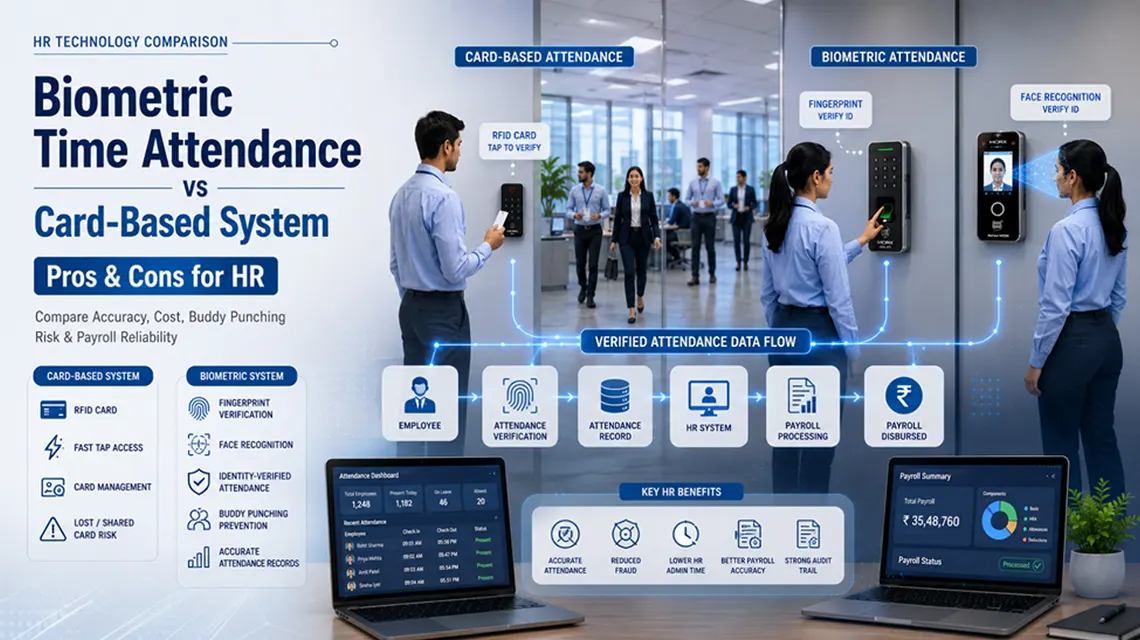
Every HR team eventually faces this decision when setting up or upgrading attendance infrastructure: stick with RFID cards, or move to biometric identification. Both solve the basic problem - recording when employees arrive and leave - but they solve it very differently, and the difference shows up in payroll accuracy, fraud risk, and how much ongoing management the system needs. This comparison lays out exactly what each option means for HR in practice.
A card-based attendance system issues each employee an RFID or proximity card. At the entry point, the employee taps or swipes the card against a reader, which logs the timestamp against that card's assigned employee ID. It's fast, familiar, and requires no enrollment process beyond issuing the card.
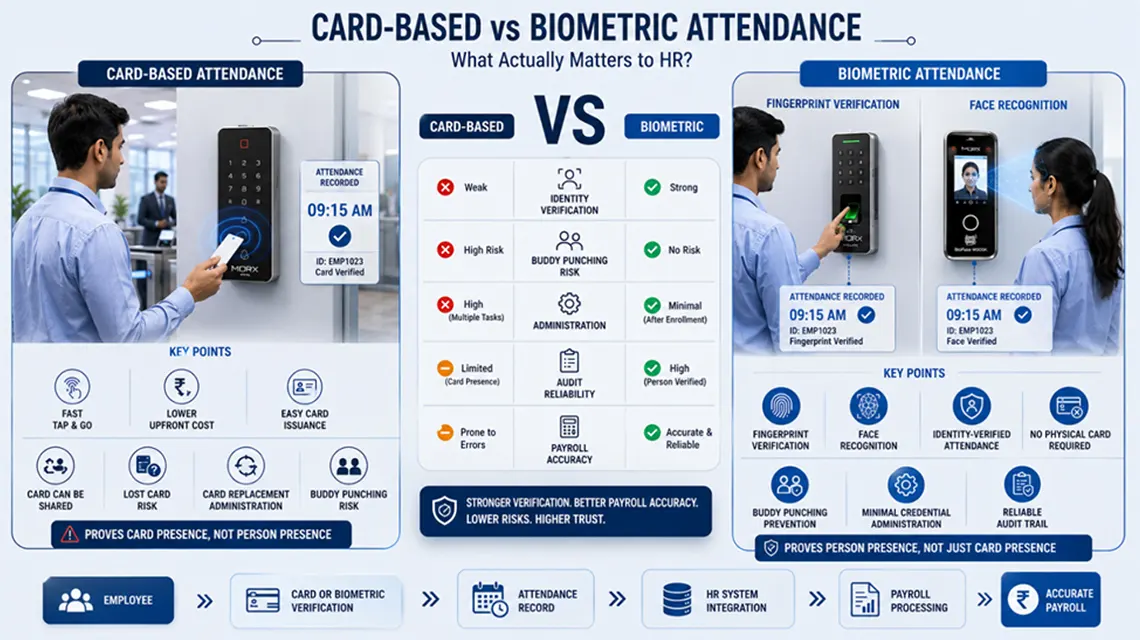
The core weakness for HR is the last point: a card proves that a card was present, not that the right person was present. This is the exact gap that leads to buddy punching - one employee tapping a colleague's card to mark them present when they haven't actually arrived.
A biometric attendance system identifies the employee directly, using fingerprint or face recognition, rather than relying on something they carry. There's no card to lose, forget, or lend to someone else - the credential is the person.
Fingerprint machines remain the standard choice for most offices - fast, accurate, and cost-effective for workforces with consistent hand condition. For environments where that's a genuine concern - factories, warehouses, construction sites - face recognition attendance systems solve the same problem without any physical contact at all, identifying employees in under a second regardless of hand condition.
| Factor | Card-Based | Biometric |
|---|---|---|
| Buddy punching risk | High - cards are easily shared | Effectively eliminated |
| Upfront hardware cost | Lower | Higher |
| Ongoing administration | Card replacement, deactivation | Minimal after enrollment |
| Enrollment effort | None (just issue card) | One-time, few seconds per employee |
| Hygiene (physical contact) | Card tap (low contact) | Fingerprint = contact; face recognition = none |
| Audit trail reliability | Confirms card presence, not identity | Confirms actual identity |
| Best fit | Low-risk environments, visitor tracking | Payroll-linked employee attendance |
Card readers cost less upfront, and that's often where the comparison stops in a budget conversation. But the real cost to HR isn't the device price - it's what happens when the system produces a wrong number. A buddy-punched card creates a payroll entry for someone who wasn't actually present. Multiply that across a workforce of several hundred employees over a year, and the disputed hours, HR time spent investigating, and the trust erosion when employees suspect a colleague is gaming the system add up to a cost that doesn't show up on the initial purchase order.
Biometric hardware costs more per device, but for organizations where payroll accuracy and fraud prevention matter more than minimizing upfront spend, the total cost comparison usually favors biometric once buddy punching and card administration are factored in.
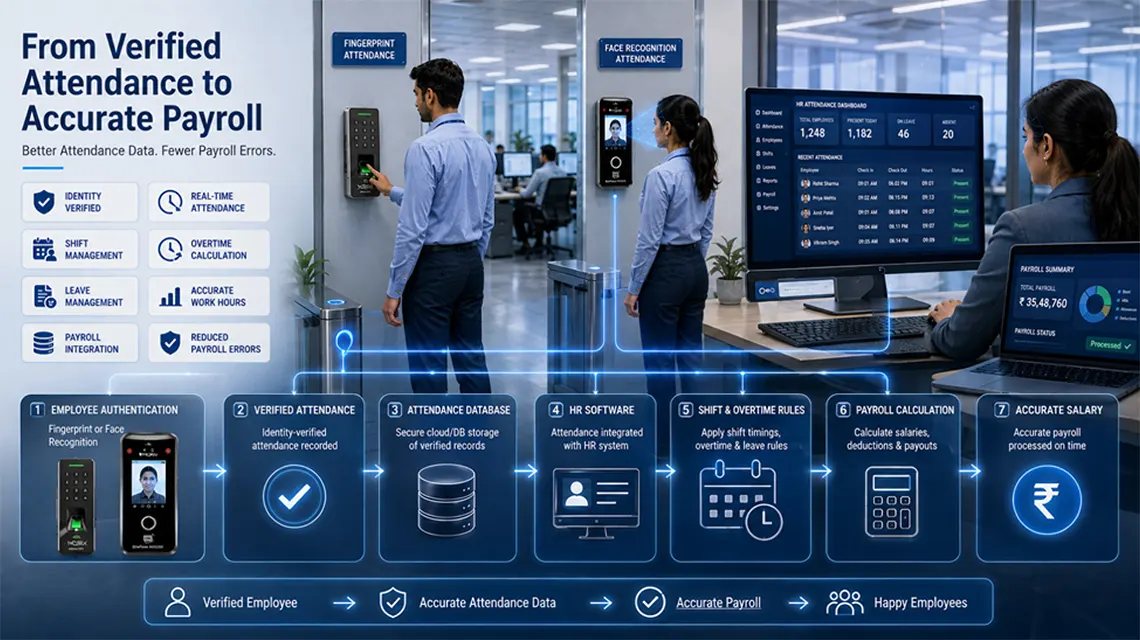
Neither a card reader nor a biometric device calculates payroll on its own - both need to feed into HR software that applies shift rules, overtime, and leave policy. This is where the accuracy gap between the two hardware types actually shows up in the paycheck. A card-based system feeding inaccurate (buddy-punched) data into payroll software just automates the error faster. A biometric system feeding accurate identity-verified data into the same software produces accurate payroll from the start.
MinopCloud connects directly with biometric attendance devices, converting verified punch data into automated payroll calculations - removing manual reconciliation and, because the underlying data is accurate, removing the disputes that come from questionable attendance records.
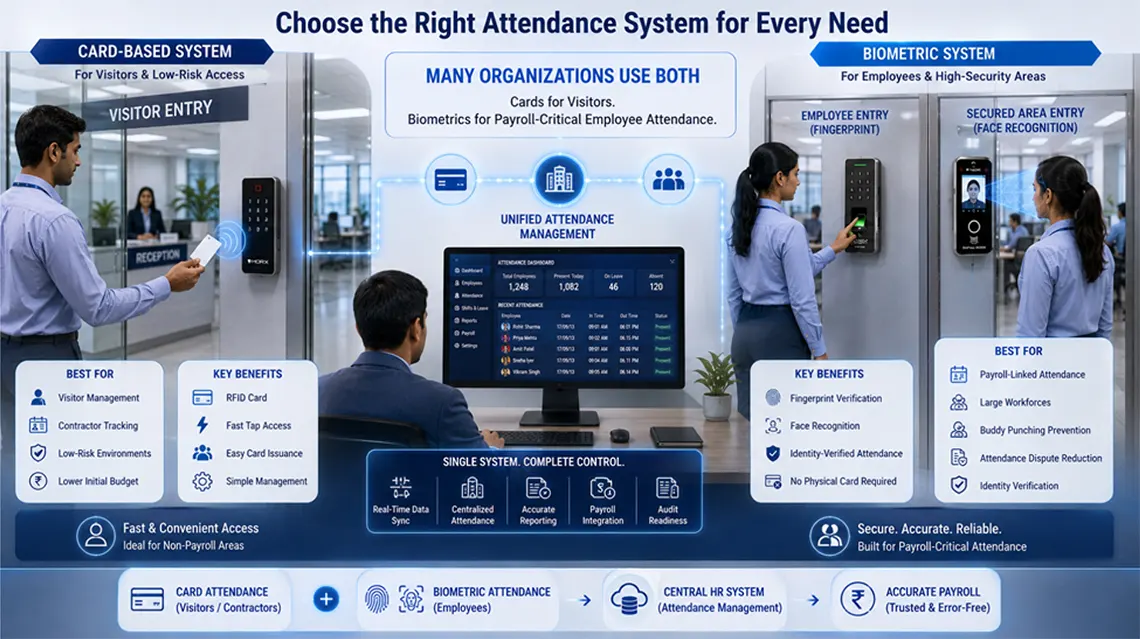
Choose card-based if: the priority is visitor or contractor tracking rather than payroll-linked employee attendance, the workforce is small enough that buddy punching risk is low and easily caught, or budget constraints make the lower upfront hardware cost the deciding factor for a first deployment.
Choose biometric if: attendance data feeds directly into payroll and overtime calculations, the organization has experienced buddy punching or attendance disputes in the past, or the workforce size makes manual verification of attendance authenticity impractical.
Many organizations end up running both - a card-based system for visitor management and low-security zones, alongside biometric devices for employee payroll attendance at the doors and terminals where accuracy actually determines what shows up in someone's salary.
Most access control infrastructure - wiring, controllers, and software - supports both card and biometric readers on the same backend. HR teams often start with card-based systems and add biometric devices at specific high-risk locations without a full system replacement.
It eliminates disputes caused by proxy or buddy punching, since the identity verification itself can't be faked with a shared credential. Disputes from other sources - device malfunction, connectivity issues, or misapplied shift rules - still require connected payroll software to resolve accurately.
Face recognition avoids the reliability issues fingerprint sensors can have with worn, dry, or dirty hands common in industrial and manual labor roles, making it the more consistent choice for factory and warehouse attendance.
Enrollment typically takes a few seconds per employee and is a one-time process. Most resistance, where it exists, stems from unclear communication about data use - HR teams that explain the system is for attendance verification only, not surveillance, generally see quick adoption.
Mivanta supplies both card-based and biometric attendance hardware to organizations across India as a B2B distributor, along with connected payroll software for full automation. Explore the complete Biometric Attendance System range to compare fingerprint, face recognition, and card-based options for your workforce.

Subscribe to our emails about secure life. No spam.