
PAN India — B2B Distribution Network
PAN India — B2B Distribution Network

Posted on 12th Sep 2026 by Admin
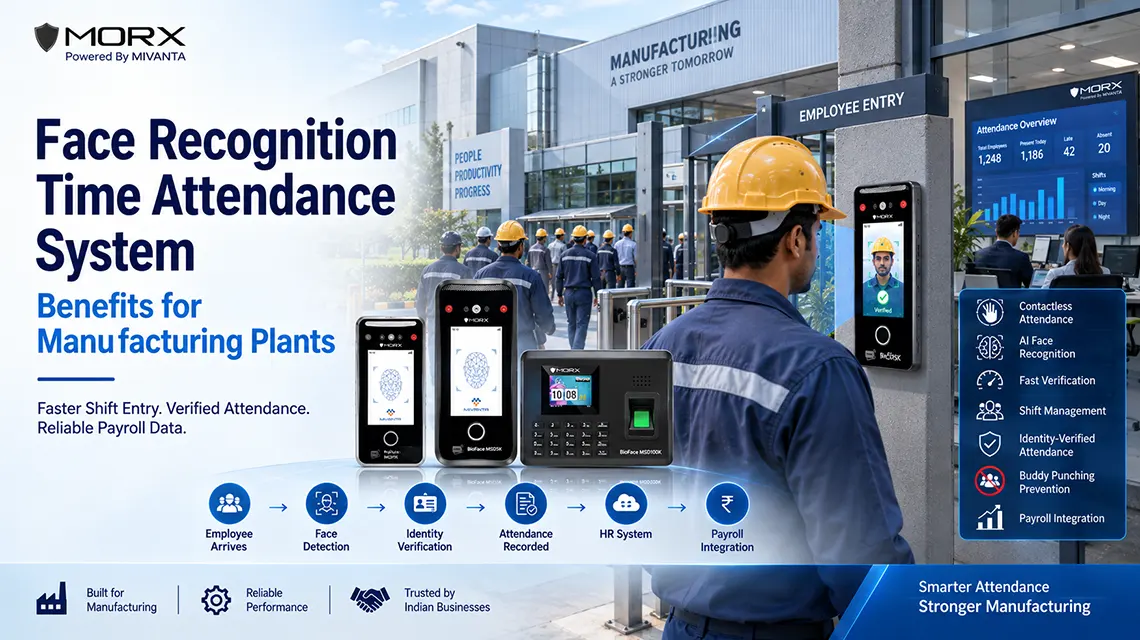
Fingerprint attendance systems work well in offices. On a factory floor, they run into a problem offices never face: hands that don't cooperate with the sensor. Workers handling metal, grease, chemicals, or repetitive manual tasks develop worn, dry, or calloused fingerprints that fail to match reliably — turning what should be a two-second punch-in into a repeated retry, and eventually into a queue at the gate during shift change. This article looks at why face recognition solves this specific problem, and what it actually changes for manufacturing plant operations.
A fingerprint sensor reads the ridges and valleys of a finger's surface. Workers in manufacturing, machining, textile, chemical, and food processing roles often have fingerprints altered by their daily work — worn smooth from friction, dried out from chemical exposure, or temporarily obscured by grease, dust, or minor cuts. None of this affects the worker's identity, but it directly affects whether the sensor can get a clean read.
The operational result is predictable: repeated failed punches, workers re-trying multiple times at the gate, and — when frustration sets in — supervisors manually marking attendance as a workaround, which reintroduces exactly the proxy-attendance risk biometric systems were installed to prevent in the first place.
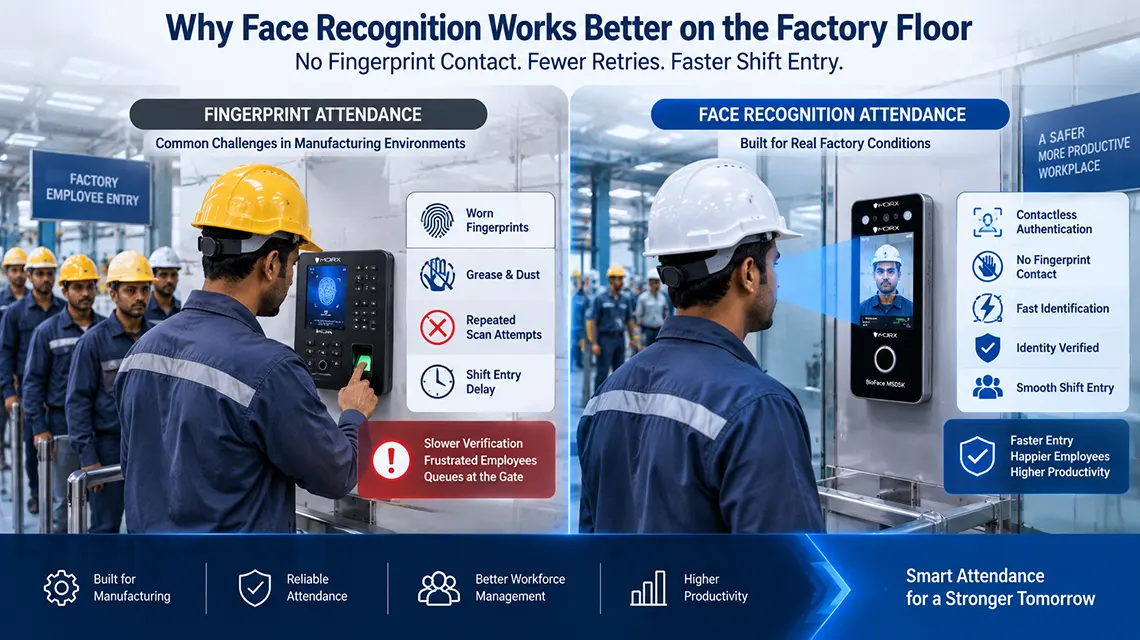
Face recognition attendance systems workers using a camera rather than a physical sensor, which means hand condition — grease, calluses, dryness, minor injuries — has no effect on verification accuracy at all. The system captures a facial image, matches it against enrolled templates, and confirms identity in under a second, without requiring anyone to touch anything.
This isn't a minor convenience upgrade over fingerprint — for a plant where a meaningful percentage of the workforce has fingerprint match issues on any given day, it's the difference between a gate that moves smoothly and one that backs up every single shift change.
When 300 to 500 workers arrive within a 15-to-20-minute shift-change window, verification speed at the gate determines whether that window stays smooth or turns into a queue stretching outside the compound. Face recognition devices like the Morx BioFace MSD5K process each verification in under a second, maintaining that speed even under continuous high-volume load — a fingerprint queue, by contrast, slows dramatically the moment several workers in a row need repeated attempts.
Proxy attendance — one worker punching in for an absent colleague — is a persistent problem on factory floors with large, shift-based workforces, and it directly costs money through paid hours for absent workers. A face cannot be handed to someone else the way a card or PIN can, so face recognition removes this fraud vector at the identification layer itself, rather than relying on supervisor vigilance to catch it after the fact.
Manufacturing environments come with variable lighting, PPE requirements, and appearance changes across a worker's career — none of which a fingerprint system needs to account for, but all of which a face recognition system must handle correctly to stay reliable. Morx BioFace devices use AI dynamic face recognition that continues refining a worker's template over time, adapting to gradual changes in appearance (weight change, facial hair, aging) so accuracy doesn't degrade months after initial enrollment — a real concern for a workforce enrolled once and expected to use the system reliably for years.
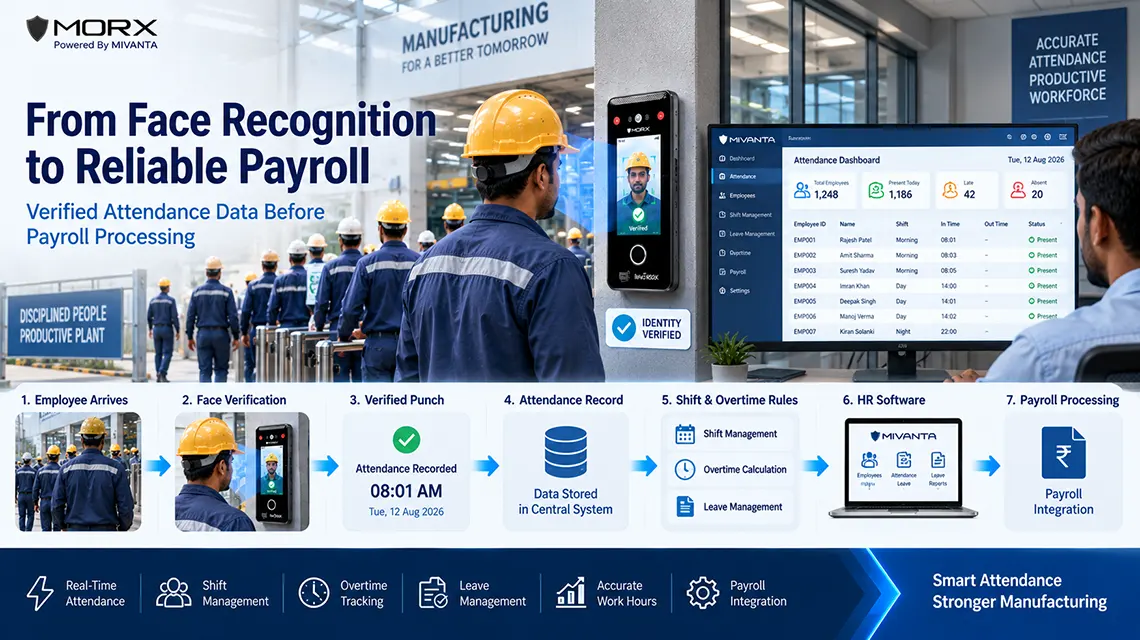
A verified punch is only useful if it turns into accurate payroll without manual reconciliation. MinopCloud and PayTime Pro connect directly with Morx face recognition devices, converting shift-based attendance data into automated overtime, late-mark, and leave calculations — removing the manual spreadsheet step that reintroduces errors even when the underlying attendance data itself is accurate. For a plant running multiple shifts across a large workforce, this is where face recognition's accuracy advantage actually shows up in the paycheck, not just at the gate.
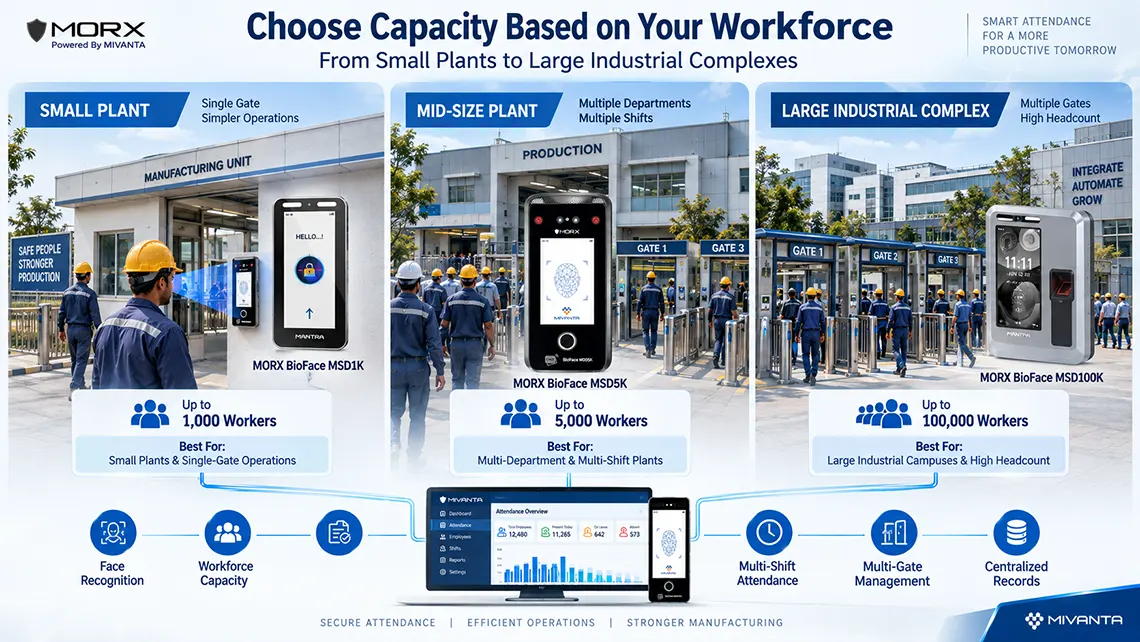
Face recognition devices are rated by how many face templates they can store, and matching this to actual plant headcount matters — an undersized device creates enrollment bottlenecks as the workforce grows.
Small plants (up to 1,000 workers) — The BioFace MSD1K covers single-shift or small multi-shift operations with a single gate, offering full AI recognition capability without paying for capacity the plant doesn't need yet.
Mid-size plants (up to 5,000 workers) — The BioFace MSD5K handles larger, multi-department facilities with higher daily throughput, suited to most mid-size manufacturing operations running two or three shifts.
Large industrial complexes (up to 1,00,000 workers) — The BioFace MSD100K is built for large industrial campuses with multiple gates and very high headcount, where centralized workforce management across dozens of entry points matters as much as individual device capacity.
Lighting at the gate — Outdoor or poorly lit entry points need devices with IR capability to maintain accuracy in low light and after dark, relevant for plants running night shifts.
Dust and industrial exposure — Devices installed near production floors or outdoor compound gates should carry adequate IP-rated housing to handle dust and humidity common in industrial settings.
Multi-gate consolidation — For plants with more than one entry point, ensure devices connect to a shared network so attendance data consolidates into one system rather than requiring separate reports per gate.
Modern AI-based face recognition can identify partial facial features with reasonable accuracy, but full mask coverage reduces reliability. For plants with mandatory mask zones, positioning devices at points before mask-wearing areas, or pairing with a secondary fingerprint or card option, keeps verification reliable.
Each worker's enrollment typically takes a few seconds at the device. For a 2,000-person plant, staggered enrollment over a few days during onboarding or a dedicated enrollment drive is the practical approach rather than trying to enroll everyone in a single session.
Many plants run face recognition as the primary method at high-traffic gates while keeping fingerprint or card-based backup at secondary entry points, giving flexibility for workers whose face isn't clearly captured on a given day due to lighting or equipment.
No — Morx face recognition devices are designed to integrate with connected workforce software like MinopCloud and PayTime Pro, so plants moving from fingerprint to face recognition typically keep their existing payroll process, just with more reliable underlying attendance data.
Mivanta supplies face recognition attendance devices across the full capacity range to manufacturing plants and industrial facilities across India as a B2B distributor. Explore the complete Face Recognition Devices range to find the right capacity for your workforce.

Subscribe to our emails about secure life. No spam.