
PAN India — B2B Distribution Network
PAN India — B2B Distribution Network

Posted on 13th Oct 2026 by Admin
If you've spent any time comparing RFID options for your business, you've probably hit the same wall I did. Vendors throw around UHF and HF like you already know the difference. Nobody stops to explain what either one actually means for your warehouse, your retail floor, or your gate.
And that confusion gets expensive. Pick the wrong frequency and you end up with a reader that can't see tags from more than a foot away, or a system that chokes the moment you try to scan more than a handful of items at once. I've seen business owners buy the wrong kit, realize it mid-rollout, and quietly eat the cost of starting over.
So let's clear this up. No jargon dump, just a straight answer to the question you actually came here with.
RFID stands for radio frequency identification. A small chip, called a tag, stores a bit of data. A reader sends out a radio signal, the tag wakes up and responds, and the reader logs what it saw. No scanning barcodes one by one. No lining anything up.
The frequency a system runs on decides almost everything else. How far the reader can hear a tag. How many tags it can read at once. How well it handles real-world clutter like metal shelving or a crate of bottled water.
Three frequency bands exist, but for most businesses it comes down to two: HF and UHF.
HF RFID runs at 13.56 MHz, under the ISO 15693 and ISO 14443 standards. You've probably used it today without realizing it. Tap-to-pay cards, hotel key cards, library tags, most access fobs, they're all HF.
It works through inductive coupling, which just means the tag needs to sit close to the reader, usually inches to about a meter at best. That's not a flaw. It's the point. HF was built for situations where you want certainty over distance. You want to know exactly which card tapped that door, not every card within shouting range.
HF also handles metal and liquid better than UHF, and it tends to come with stronger built-in security, which is why banks and transit systems lean on it so heavily. The tradeoff is scale. Most HF readers top out around 20 tags at a time.
UHF RFID runs in the 860 to 960 MHz range under the ISO 18000-6C standard, and it plays a completely different game. A UHF tag doesn't need to sit on top of the reader. It can be picked up from a meter away, ten meters away, sometimes twenty or more, depending on the reader and the environment.
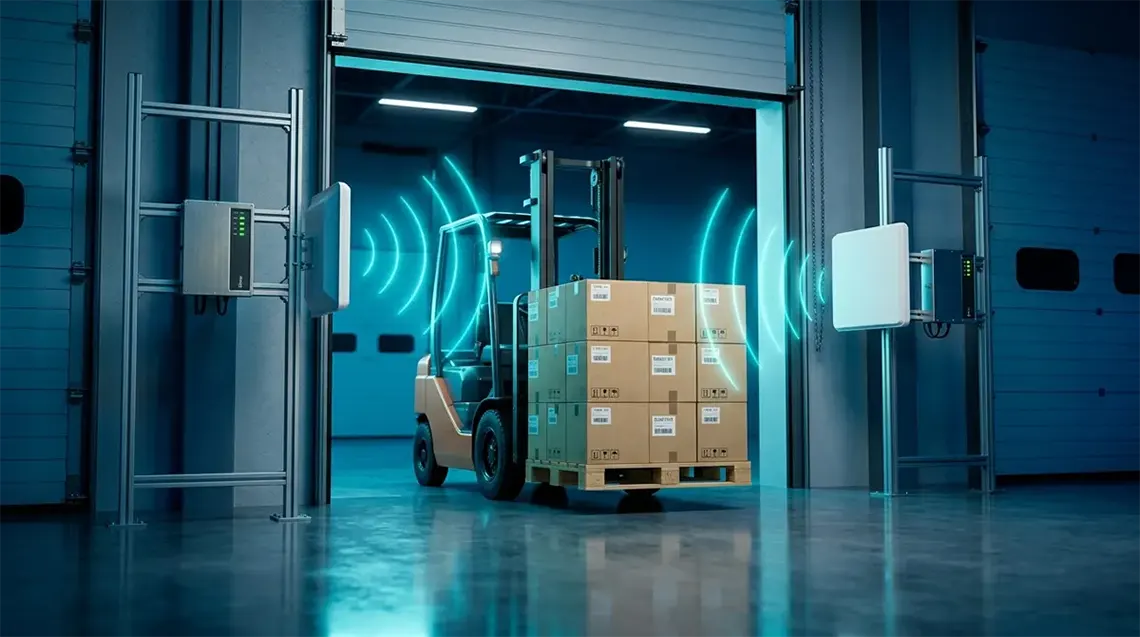
That range changes what's possible. A reader mounted at a warehouse gate can log every pallet rolling through without anyone lifting a scanner. A handheld device can sweep a full shelf of inventory in seconds instead of minutes. UHF readers can pick up hundreds of tags in a single pass, where HF is still counting past twenty.
I'll be honest about the catch, because too many vendors won't mention it. UHF signals don't love metal or liquid. They can bounce off or get absorbed, which knocks down read range if tag placement isn't thought through. Good antenna placement and the right tag design handle most of this.
Strip away the spec sheets and here's what it comes down to.
Range. HF gets you inches to about a meter. UHF gets you several meters, often ten or more. If you're scanning something across a room or a loading dock, that gap decides everything.
Speed and volume. HF reads tags almost one at a time in practice. UHF reads dozens or hundreds in a single pass, which is why it runs most supply chain and inventory work.
Cost at scale. UHF tags are generally cheaper to produce in bulk, and that matters once you're tagging thousands of items instead of a few hundred.
Interference. HF shrugs off metal and water better. UHF needs smarter tag placement around those materials, though anti-metal tags close most of that gap now.
Security. HF has the longer track record in high-security work like payments. UHF has caught up a lot, but for a secure access card, HF still has the edge.
I'm not here to tell you UHF wins every time. It doesn't.
If you're running access control for a handful of doors, managing a library, or need item-level certainty where you want to know the exact tag that triggered a read, HF still does that job well. Payment cards, employee badges, and small-batch asset tags where range doesn't matter all lean HF for good reason.
If your whole operation fits within arm's reach of the reader, you probably don't need UHF's extra range, or its sensitivity to metal and liquid.
But if you're running a warehouse, managing inventory across a retail floor, tracking vehicles through a gate, or trying to get visibility on assets scattered across a facility, UHF is almost always the right call. It isn't close.
Think about what you're actually trying to solve. You want pallets logged the moment they roll through a dock door, without a worker scanning each one by hand. You want a stocktake that takes twenty minutes instead of a full shift. You want a gate that recognizes an authorized vehicle from fifteen meters out and lifts the barrier before the driver even slows down.
That's the whole reason UHF exists. It's why it's become the dominant technology for supply chain, logistics, and industrial tracking worldwide. The hardware costs more upfront, sure, but the labor hours you get back usually pay for that within months, not years.
Here's where I'll get practical instead of theoretical. A working UHF setup isn't one box you buy. It's a handful of components that need to fit your space and your workflow.
You'll need a UHF reader, and the type matters. A fixed reader sits at a gate or dock door and reads continuously without anyone touching it. A handheld reader travels with your team for stocktaking and spot checks. For wide openings like warehouse gates or boom barrier lanes, you'll often pair that reader with a separate RFID antenna to stretch coverage across the full width, since one reader alone can't always cover a wide portal.
None of it works without the RFID tags themselves. What you're tagging decides the tag you need. A pallet needs something different than a vehicle windshield or a small carton. Get that wrong and you'll fight interference you didn't need to deal with.
At Mivanta, we put together complete UHF solution combinations, readers, antennas, and tags that are actually meant to work together, instead of three parts from three vendors that you're left hoping line up.
If I had to boil this down to one line: HF is for close, certain, secure reads. UHF is for speed, scale, and distance. Most businesses I talk to land on UHF once we actually walk through what they're trying to do. Not because it's trendy. Because warehouses, retail backrooms, and vehicle gates almost always need range and volume more than they need proximity.
Figure out your real use case first. How far does the read need to reach? How many items are you scanning at once? Is metal or liquid part of the picture? Answer those honestly, and the choice between UHF and HF mostly makes itself.

Subscribe to our emails about secure life. No spam.