
PAN India — B2B Distribution Network
PAN India — B2B Distribution Network

Posted on 20th Jul 2026 by Admin
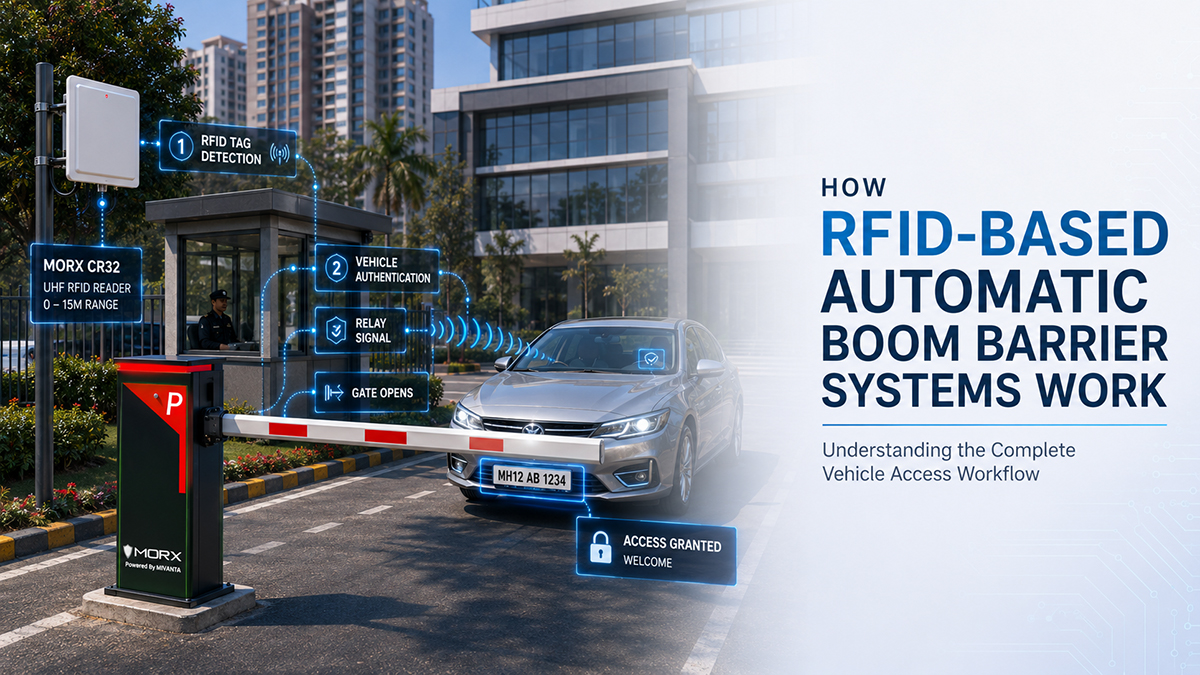
Anyone who has watched a car glide through a society gate without stopping has seen an RFID-based boom barrier system in action. What looks instant to the driver is actually four separate pieces of hardware talking to each other in under a second — a tag, a reader, a relay, and a motor. This article breaks down exactly how each piece works and how they connect, using real wiring interfaces from actual boom barrier and RFID reader hardware.
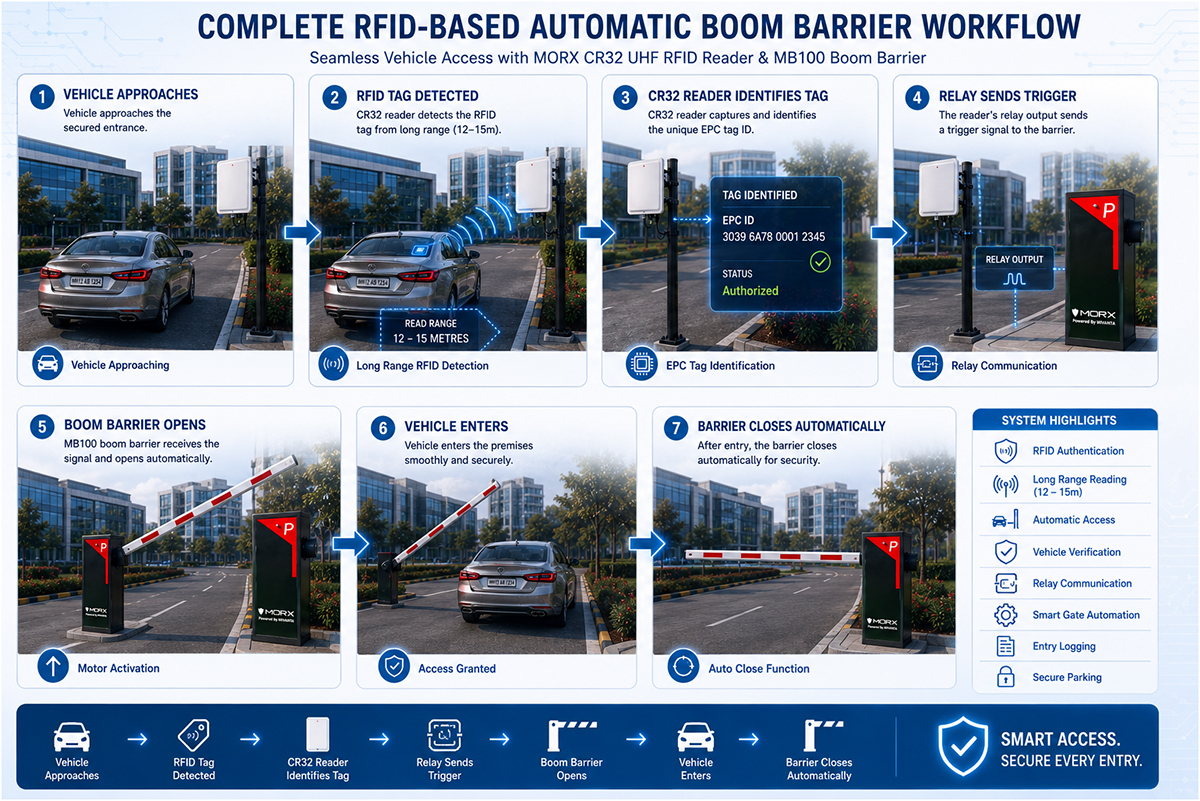
Every RFID-based automatic boom barrier setup — regardless of brand — is built from the same four components:
1. RFID Tag — A passive UHF tag mounted on the vehicle's windshield. It has no battery; it reflects a radio signal back to the reader when energized by the reader's own transmission.
2. UHF RFID Reader — Mounted near the gate, this device continuously transmits a radio signal and listens for tag responses. When a tagged vehicle enters its read zone, the reader captures the tag's unique ID.
3. Relay / Controller — The decision-making link. It receives the tag ID from the reader, checks it against an approved list, and sends an electrical trigger signal to the barrier motor if the vehicle is authorized.
4. Boom Barrier Motor Unit — The physical gate. On receiving the trigger signal, the motor drives the arm up, holds it open long enough for the vehicle to pass, then closes it automatically.
The entire sequence — from the tag entering read range to the arm rising — typically completes in under a second.
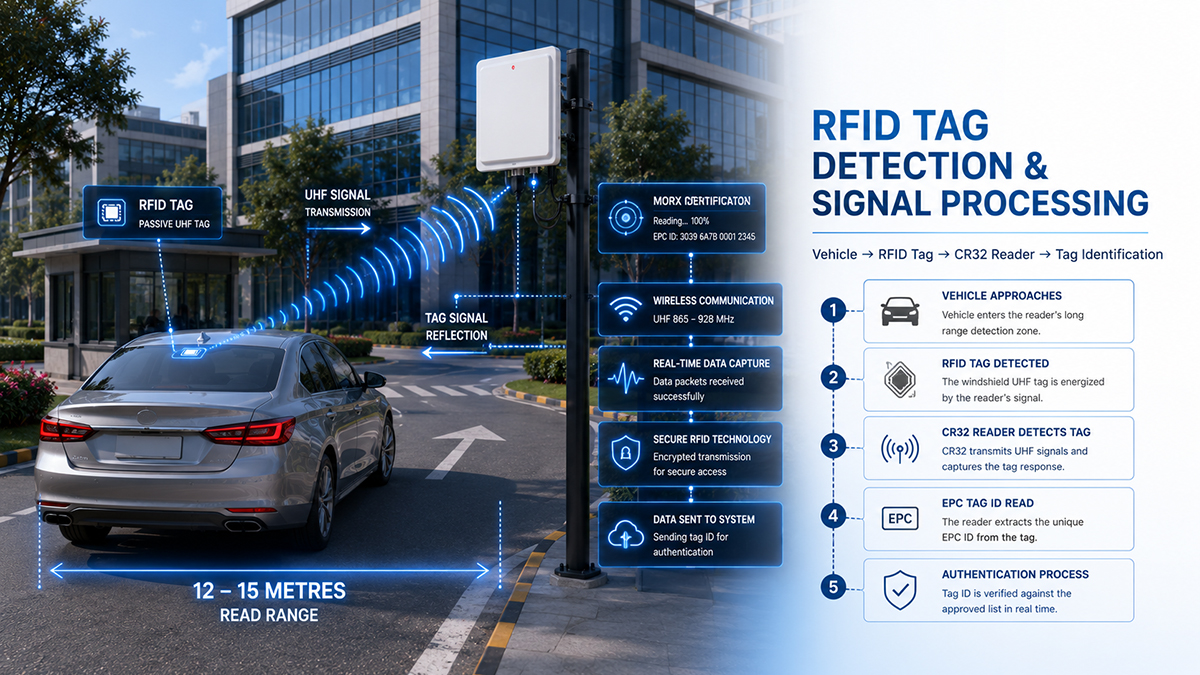
A UHF RFID tag does not need line-of-sight or close contact to be read — this is what separates it from a barcode or a swipe card. The MORX CR32 UHF integrated reader, for example, reads tags from 12 to 15 metres away using a built-in 12dBi linear antenna, operating in the 865–928 MHz frequency band. At a car's normal approach speed, this means the tag is read and the gate command is issued well before the vehicle reaches the barrier arm — the driver never has to slow down.
Read range depends on the tag type, the antenna gain, and environmental conditions (metal surfaces, other RF interference, and antenna orientation can reduce effective range), which is why installers typically test read distance on-site rather than relying purely on the datasheet figure.
Once a tag enters the reader's field, the reader demodulates the reflected signal and extracts the tag's unique identifier — typically an EPC (Electronic Product Code) stored on the tag. The CR32 supports the ISO18000-6B and ISO18000-6C (EPC Class 1 Gen 2) protocols, the global standard for UHF RFID tags, which is why tags from different manufacturers remain compatible with the reader as long as they follow the same protocol.
The reader can operate in different modes depending on the installation — active mode (continuously scanning), trigger mode (activated only when a separate sensor detects a vehicle), or answer mode. Trigger mode is common at boom barrier installations because it reduces unnecessary reads from vehicles simply parked nearby rather than approaching the gate.
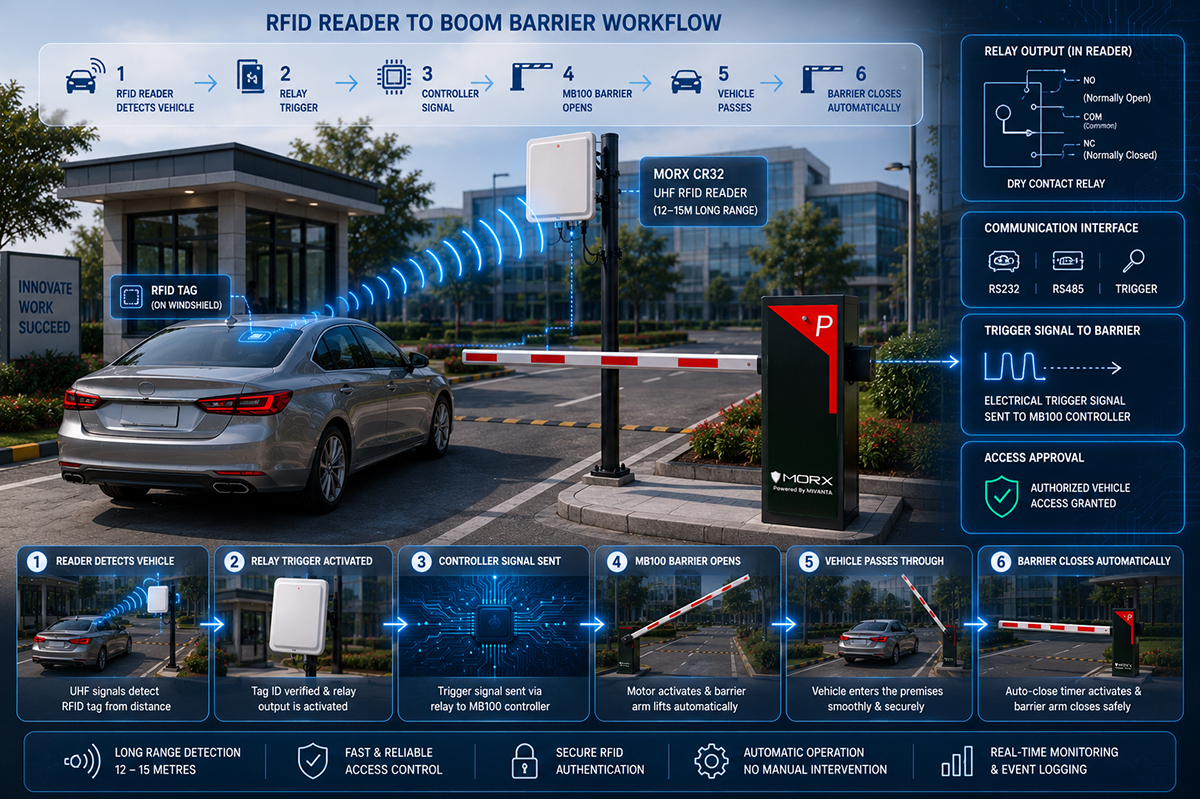
This is the step most people don't see, and it's the one that actually opens the gate. Once the reader confirms the tag ID belongs to an authorized vehicle, it needs a way to physically tell the barrier motor to move. This happens through a relay output — an electrical switch inside the reader (or a separate controller) that closes a circuit when triggered.
The CR32 has this relay built directly into the reader unit, along with RS232, Wiegand 26/34, and trigger interfaces. Having the relay inbuilt matters practically — it means the reader can connect straight to the barrier's control panel without needing a separate access controller as an intermediate device. Fewer components between the tag read and the gate opening means fewer points of failure and a simpler installation.
For installations where the vehicle list needs to be managed centrally — multiple gates, a blacklist, or logging — the relay signal instead routes through an access controller, which handles the authorization logic before sending the trigger to the barrier.
On the barrier side, the MB100 automatic boom barrier is built specifically to accept this kind of external trigger. It runs on a 24V DC brushless motor and includes an external interface designed for loop detectors, radar sensors, photocells, and access controllers with UHF readers — meaning the RFID relay signal plugs into a purpose-built input rather than a workaround.
When the trigger signal arrives, the MB100's control panel processes it through its RS232/RS485 communication interface and commands the motor to lift the arm. The motor's soft-start and soft-stop function means the arm accelerates and decelerates smoothly rather than snapping open — reducing mechanical wear over thousands of daily cycles. Ground sensing and anti-crushing input signals are also monitored throughout the cycle, so the barrier stops or reverses if an obstruction is detected while closing.
Once the vehicle clears the loop sensor on the far side, the auto-close function lowers the arm automatically — no second trigger required.
At a busy gate — a factory shift change, a society during morning rush — the entire tag-read-to-arm-open sequence needs to complete before the vehicle arrives, not after. This is why read range matters as much as read accuracy: a reader with a 15-metre range gives the system roughly 3 to 4 seconds of processing time at typical approach speed, comfortably enough for detection, identification, relay trigger, and motor actuation to complete in sequence.
It's also why the physical connection matters. A direct relay connection (reader to barrier, no intermediate hardware) has fewer places where a signal can be delayed, dropped, or misconfigured compared to a chain running through multiple controllers. For single-gate installations — a residential society entrance, a single-lane office gate — the direct relay setup using something like the CR32-to-MB100 pairing is usually the simplest and most dependable configuration.
If a vehicle without a registered tag — or with no tag at all — approaches the gate, the reader either finds no match in its authorized list or gets no signal response at all. No relay trigger is sent, and the barrier stays closed. This is where most installations add a second identification path — an ANPR camera reading the number plate, or an intercom to the security cabin — so visitor vehicles aren't simply turned away but are routed through manual verification instead.
This is also why power backup matters on the barrier itself. The MB100 includes provision for manual lift and lower via a motorized hand wheel, plus support for an external 12V battery during power failure — so the gate doesn't become a physical obstruction if power is lost mid-operation.
The MORX CR32 reads UHF tags from 12 to 15 metres under standard conditions, depending on the tag and the surrounding environment. This gives enough distance for the barrier to open before the vehicle reaches the arm.
It can go either way. The CR32 has an inbuilt relay that connects directly to a boom barrier's control panel — no separate controller required for a single-gate setup. For multi-gate installations needing centralized vehicle list management, the reader instead connects through an access controller.
The reader only sends a trigger for tags it recognizes as authorized — an unregistered vehicle produces no match and no relay signal. Trigger mode, which activates the reader only when a loop sensor confirms a vehicle is actually approaching the gate (not just nearby), adds a further layer of accuracy.
The MB100 includes a manual hand-wheel release for lifting and lowering the arm by hand, and supports an external 12V battery backup so the barrier can continue limited automatic operation during short outages.
Yes — the RFID reader and relay logic works the same way at each gate. For multi-gate sites, the trigger signals typically route through a shared access controller so vehicle authorization lists, entry logs, and blacklists stay synchronized across every gate rather than managed separately at each barrier.
Mivanta supplies the complete hardware chain for RFID-based boom barrier systems — UHF readers, boom barriers, and access controllers — as a B2B distributor across India. Explore the full Boom Barrier range and UHF RFID Reader range to compare models by read range and interface, or contact our sales team for project-specific wiring and integration guidance.

Subscribe to our emails about secure life. No spam.